
This column of news, views and snippets from the international literature of books, libraries, and information, was written in September and appeared in the December 2024 issue of LIASA-in-Touch, the quarterly newsletter of the Library and Information Association of South Africa.
The good
On the fringes of the 2023 IFLA World Library and Information Congress in Rotterdam, the Netherlands, a small reception was held to hand over a Festschrift to Dr Helena Asamoah-Hassan, a leading Ghanaian librarian who is the current Executive Director of the African Library and Information Associations and Institutions (AfLIA). Dr Asamoah-Hassan is well-known internationally. She was AfLIA’s first President and also served as a member of IFLA’s Governing Board.
What is a Festschrift? This German word refers to a publication containing essays or chapters contributed by friends and former colleagues in honour of a respected academic or professional leader, usually at some milestone such as retirement or a 70th birthday. (It is mostly spelled with a capital F, because all German nouns are capitalized.)
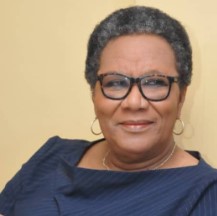
Dr Helena Asamoah-Hassan (Wikipedia)
This Festschrift (Okojie and Abdullahi 2023), professionally edited by Victoria Okojie and Ismail Abdullahi, and published in Accra, Ghana, is the best example I have seen in several decades of a Festschrift produced by the African LIS profession. Its 393 pages comprise 24 chapters by African authors on topics mostly relating to African LIS. Two of these deal with AfLIA’s history and achievements (Appiah 2023; Sam, Boakye-Achampong, and Appiah 2023). Given the various failed and faltering continent-wide LIS associations that preceded it, AfLIA is indeed a welcome success story. Various other topics of current interest to African LIS professionals are dealt with. These include information technology issues such as artificial intelligence (Momame, Abifarin, and Imavah 2023), fake news, misinformation and cyberethics, knowledge management, library leadership, mentoring and coaching, needs of visually impaired students, and copyright management. A worthy tribute to Dr Asamoah-Hassan, and a credit to the African library profession.
Still under the heading of “The good”, I draw attention to a recent special issue of IFLA journal (vol. 50, no. 1, 2024) which contains fourteen articles based on papers delivered at the thirty-first BOBCATSSS Conference in 2023. These annual conferences are organised by students of European LIS schools. The name BOBCATSS is an acronym which derives from the names of the cities of the first nine universities which participated in this initiative (Budapest, Oslo, Barcelona, Copenhagen, Amsterdam, Tampere, Stuttgart, Szombathely, and Sheffield). For more background, see the introductory essay by the issue editors (Zaman Shuva et al. 2024). This is an excellent set of papers written mainly by students at these LIS schools. A wide range of topics is covered. One that caught my attention is a report on research towards a “STEAM model for digital fluency skills”, where STEAM expands STEM (science, technology, engineering and mathematics) to include Arts. This means adding elements of creativity and imagination, and different ways of seeing things. “Digital fluency” or “transliteracy”, goes beyond digital literacy in using technology and different tools to “create something new” in different genres, modalities and media (Encheva et al. 2024). Another paper reports on the information behaviour of the Brazil’s Terena people. Brazil has 305 ethnic groups speaking 274 languages. In planning a multicultural library to serve a community such as this, cultural factors in information seeking and use must be understood and taken into account (Teixeira et al. 2024).
The bad
Fake news is nothing new. “Photoshopping” to enhance or distort images has been around for decades. Now artificial intelligence is available to do just that, more rapidly and more convincingly. In a BBC report, examples are shown of how AI can be used in electioneering to burnish a candidate’s image and to damage that of an opponent. Do you want to damage the image of Mr Trump? Here’s a doctored photo of him being led away in handcuffs. Do you want to convey the message that Mr Biden is too old and frail to run for president? Here’s one of him lying on a hospital bed. AI platforms have rules to prevent this, but researchers at the Center for Countering Digital Hate have demonstrated experimentally that the rules can easily be circumvented (Wendling 2024).
Lately there has been an increase in articles reporting various kinds of misconduct, cheating and fraud in academia and scholarly communication. Denise Nicholson’s blog, Scholarly Horizons, alerted me to several of the following cases.
To get ahead, young and not so young scholars have to publish research in scholarly journals and to get cited. This is hard work, but a “paper mill” can help you. Paper mills are criminal organizations which for a fee produce manuscripts and submit them to academic journals, so as to pad the client’s list of publications (Bouter 2024a; 2024b). They constitute a serious threat to scholarship by polluting the scholarly literature and inflating the citation counts of undeserving scholars (Kchozyan 2024; Waruru, n.d.). Another way to pad your CV quickly is to publish in a predatory journal (Grudniewicz et al. 2019). Publishers of these journals can be very devious. One method they use is to “clone” or “hijack” an existing journal. This can be done by creating a carefully imitated fake website for an existing high-status journal, creating a new website for a journal which has ceased publication, using an earlier title of a journal which has changed its title, or by making small changes to the title, for example by adding the word “American” or “International” to the title, or replacing the preposition “of” with “for” (Abalkina 2023; Parray, Loan, and Khan 2024).
Citation counts are important for academic appointment and promotion. More citations, higher status, more research grants, more senior positions… Recently a really sneaky way to increase the number of citations to a person’s work is to conceal fabricated references in the metadata of an article at the time when the Digital Object Identifier (DOI) is registered. The rogue citations are not visible to the reader, but they are counted by systems that generate citation counts. Quite how this is done is beyond me, but read the article (Besançon et al. 2024).
The ugly
Kathleen McCook’s website, “Ebla to eBooks: the preservation and annihilation of memory”, is a useful source of current information on the fate of the world’s cultural heritage. Ebla? Ebla is the name of an ancient city in what is now Syria, which was destroyed by Akkadian invaders in 2300 BCE. In the ruins of the palace archives, archaeologists found many clay tablets, some intact, some broken, and many fragments, that had been used to record ritual and literary texts as well as bureaucratic information. It is thought to have been the earliest recorded case of the destruction of a library.
Fast forward to our own millennium and libraries continue to be damaged or destroyed. Some suffer damage due to weather events. Kathleen’s site recently reported on the flooding of the Smithtown Library on Long Island, New York state, which housed the Long Island Historical Collections. It was seriously damaged by a flood in August this year.
Bureaucratic and political decisions can also have disastrous effects on libraries. In the United Kingdom, over 180 public libraries have closed or have become volunteer-run since 2016. A survey by the BBC found that around 950 libraries across the UK had reduced their hours during the past eight years, while 2000 library jobs have been lost due to cut-backs (Lynch, Tomas, and Hattenstone 2024). Whilst most of these smaller public libraries may not have held irreplaceable heritage materials, cutting off a significant proportion of the population from library services also means cutting people off from their heritage. We in LIASA need to remain vigilant. We can never take political support for granted. Many of our municipalities are in serious trouble. Has anyone done some research to find out what the impact of municipal dysfunction is on their public libraries?
To really destroy heritage, as in Ebla, you need drones, missiles and bombs. As of 22 August this year, UNESCO has verified damage to 435 cultural sites in Ukraine since Russia invaded Ukraine on 24 February 2022. This includes 140 religious sites, 215 buildings of historical or artistic interest, 31 museums, 32 monuments, 16 libraries and one archive.
Access to Gaza is difficult if not impossible. In the “fog of war” the air is thick with propaganda and disinformation. No source can be trusted unreservedly. Although it is difficult to assess the damage, it is clear that there has been an immense amount of destruction due to Israeli bombardment. The BBC has reported on an analysis of aerial photographs by researchers in the USA. It shows that by 29 January this year between 50% and 61% of buildings in the territory had been damaged or destroyed (Palumbo et al. 2024). This includes cultural centres, mosques, museums, archaeological sites, and educational establishments which housed libraries. According to Librarians and Archivists with Palestine, a “network of self-defined librarians, archivists and information workers in solidarity with the Palestinian struggle for self-determination”, one of the casualties is Israa University, which was blown up by the Israeli forces, completely destroying the complex, including a library and a national museum. The museum had first been looted by Israeli troops (Librarians and Archivists with Palestine 2024). From whichever side we look at it, the destruction of libraries and archives is an abomination.
Tailpiece
No tailpiece in this instalment. To place an amusing tailpiece here would trivialise the horrors that are being perpetrated today in so many warzones across the world.
References
Abalkina, Anna. 2023. “A High-Quality Cloned Journal Has Duped Hundreds of Scholars, and Has No Reason to Stop.” Retraction Watch (blog). April 4, 2023. https://retractionwatch.com/2023/04/04/a-high-quality-cloned-journal-has-duped-hundreds-of-scholars-and-has-no-reason-to-stop/.
Appiah, Doreen. 2023. “African Library and Information Associations and Institutions (AfLIA): The History of a Continental Library Association.” In International Library and Information Science Practice: Excellence in Leadership, Management and Mentorship : A Festschrift in Honour of Dr. Helena Asamoah-Hassan, edited by Victoria Okojie and Ismael Abdullahi, 15–32. Accra: Woeli Publishing Services.
Besançon, Lonni, Guillaume Cabanac, Cyril Labbé, and Alexander Magazinov. 2024. “Sneaked References: Fabricated Reference Metadata Distort Citation Counts.” Journal of the Association for Information Science and Technology n/a (n/a). https://doi.org/10.1002/asi.24896.
Bouter, Lex. 2024a. “Fake Academic Papers Are on the Rise: Why They’re a Danger and How to Stop Them – Future Media News.” March 7, 2024. https://futuremedianews.com.na/2024/03/07/fake-academic-papers-are-on-the-rise-why-theyre-a-danger-and-how-to-stop-them/.
———. 2024b. “Stop Buying Cobras: Halting the Rise of Fake Academic Papers.” Social Science Space (blog). July 22, 2024. https://www.socialsciencespace.com/2024/07/stop-buying-cobras-halting-the-rise-of-fake-academic-papers/.
Encheva, Marina, Anna Maria Tammaro, Gergana Yancheva, Plamena Zlatkova, Giulia Conti, and Mari Maasilta. 2024. “Towards a STEAM Model for Digital Fluency Skills: Perceptions of Students and Teachers.” IFLA Journal 50 (1): 75–92. https://doi.org/10.1177/03400352231209491.
Fabian, Emanuel. 2024. “IDF Says It Is Probing Demolition of Campus in Gaza Last Week, after US Voiced Ire.” Times of India. January 21, 2024. https://www.timesofisrael.com/idf-says-it-is-probing-demolition-of-campus-in-gaza-last-week-after-us-voiced-ire/.
Grudniewicz, Agnes, David Moher, Kelly D. Cobey, Gregory L. Bryson, Samantha Cukier, Kristiann Allen, Clare Ardern, et al. 2019. “Predatory Journals: No Definition, No Defence.” Nature 576 (7786): 210–12. https://doi.org/10.1038/d41586-019-03759-y.
Kchozyan, Gabriella. 2024. “Paper Mills Pose Threat to Scientific Scholarship.” The Oxford Student (blog). May 29, 2024. https://www.oxfordstudent.com/2024/05/29/paper-mills-pose-threat-to-scientific-scholarship/.
Librarians and Archivists with Palestine. 2024. “Israeli Damage to Archives, Libraries, and Museums in Gaza, October 2023–January 2024.” Librarians and Archivists with Palestine. https://librarianswithpalestine.org/gaza-report-2024/.
Lynch, Paul, Pilar Tomas, and Alix Hattenstone. 2024. “Public Libraries in ‘crisis’ as Councils Cut Services.” September 2, 2024. https://www.bbc.com/news/articles/cn9lexplel5o.
Momame, Isaiah Michael, Fasola P. Abifarin, and Shaka A. Imavah. 2023. “Evolution of Libraries in the 4th Industrial Revolution: A Review of the Adoption and Use of Artificial Intelligence and Robotics in Developed and Developing Libraries.” In International Library and Information Science Practice: Excellence in Leadership, Management and Mentorship : A Festschrift in Honour of Dr. Helena Asamoah-Hassan, edited by Victoria Okojie and Ismael Abdullahi, 49–78. Accra: Woeli Publishing Services.
Okojie, Victoria, and Ismael Abdullahi, eds. 2023. International Library and Information Science Practice: Excellence in Leadership, Management and Mentorship : A Festschrift in Honour of Dr. Helena Asamoah-Hassan. Accra: Woeli Publishing Services.
Palumbo, Daniele, Abdelrahman Abutaleb, Paul Cusiac, and Erwan Rivault. 2024. “At Least Half of Gaza’s Buildings Damaged or Destroyed, New Analysis Shows.” BBC, January 30, 2024. https://www.bbc.com/news/world-middle-east-68006607.
Parray, Umer Yousuf, Fayaz Ahmad Loan, and Aasif Mohammad Khan. 2024. “The Dark Side of Publishing: Unveiling the Deceptive Tactics of Cloned Journals in India.” Journal of Librarianship and Information Science, June, 09610006241256392. https://doi.org/10.1177/09610006241256392.
Sam, Joel, Stanley Boakye-Achampong, and Doreen Appiah. 2023. “African Library and Information Associations and Institutions (AfLIA): Africa’s Success Story.” In International Library and Information Science Practice: Excellence in Leadership, Management and Mentorship : A Festschrift in Honour of Dr. Helena Asamoah-Hassan, edited by Victoria Okojie and Ismael Abdullahi, 33–48. Accra: Woeli Publishing Services.
Teixeira, Lilian Aguilar, Ana Lúcia Terra, Oswaldo Francisco de Almeida Júnior, and Antônio Hilário Aguilera Urquiza. 2024. “Multicultural Libraries: A Study on the Information Behaviour of the Terena People, Brazil.” IFLA Journal 50 (1): 26–41. https://doi.org/10.1177/03400352231205717.
Waruru, Maina. n.d. “End Paper Mills Menace to Protect Research Integrity.” University World News. Accessed July 4, 2024. https://www.universityworldnews.com/post.php?story=20240606174901782.
Wendling, Mike. 2024. “AI Can Be Easily Used to Make Fake Election Photos – Report.” BBC, March 6, 2024. https://www.bbc.com/news/world-us-canada-68471253.
Zaman Shuva, Nafiz, Jamie Johnston, Péter Murányi, and Tania Todorova. 2024. “A New Era: Exploring the Possibilities and Expanding the Boundaries.” IFLA Journal 50 (1): 3–5. https://doi.org/10.1177/03400352241231075.


 Peter Johan Lor