This Blog

In the course of a long career in librarianship, I have held the belief that libraries and information services contribute to peace and justice through the global exchange and sharing of information and knowledge. This site is intended as a resource for all who are interested in international and comparative aspects of librarianship and information work. I focus on matters with a conceptual and historic slant, but I also indulge myself sometimes and blog to air my opinions on other topics as well.
Posted in Uncategorized | Leave a comment

Lubuto Library Partners: libraries promoting literacy

In response to what is referred to as the “literacy crisis”, my Global Gleanings column no.27 of March 2026 was devoted to literacy. I ended the column with a challenge to readers: what is your library doing to address our crisis of basic literacy?

I received the following response from Jane Kinney Meyers, the founding president of Lubuto Library Partners (LLP), a non-profit organization working in Zambia. By way of background, Lubuto is a grassroots organization that has worked for twenty years to show the important role that public libraries can play in addressing complex challenges such as gender inequality, HIV/AIDS, climate change, poverty, inadequate access to education, and lack of opportunity. Continue reading

Posted in Uncategorized | Tagged , , , , , , , | Leave a comment

Global Gleanings #28 (June 2026) AI: Awesome or Awful?

I apologise for the delayed posting of this column, which offers my usual, more or less regular news, views and snippets from the international literature of books, libraries, and information. It was written in March 2026 and appeared in the June 2026 issue of LIASA-in-Touch, the quarterly newsletter of the Library and Information Association of South Africa. I have updated it for this post.

AI! Awesome/awful intelligence

As I was writing this, the internet was abuzz with the decision of Anthropic, maker of advanced artificial intelligence systems, not to release its latest, most powerful AI model, called Mythos, generally. Anthropic was limiting the distribution of Mythos to a small number of major firms, such as big banks. Mythos had proven to be extremely effective at finding vulnerabilities in software systems. That would be very useful to IT security experts needing to protect their systems from cybercrimes. But, if Mythos should fall into the hands of bad actors, the consequences could be devastating. In the meantime, two things have happened. First, the Anthropic issue moved to the courtroom, where the company was challenging a puzzling decision by the Trump administration to label Anthropic a security risk and bar it from working with the US government. The judge ruled in Anthropic’s favour on 27 August. The human-AI interface has many dimensions… Second, the AI-AI interface also proved to be problematic. Recently there have been several incidents where large language models autonomously broke out of their “sandboxes”, where they are confined while under development, for test purposes, and hacked into other AI systems. For creating havoc, humans are not essential.

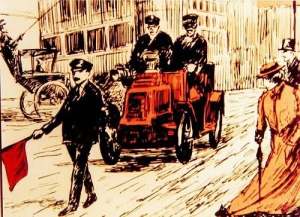
Early motor vehicle preceded by obligatory red flag (Getty Images)

It is not unusual for technological innovations to cause alarm. One of the best-known cases was the invention of the steam locomotive. In 1865 the Parliament of the United Kingdom passed a law (the “Red Flag Act”) to set speed limits for “horseless” vehicles:  two miles per hour (about 3 km per hour, a walking pace) in cities and four in the countryside. Locomotives and later, motor cars, had to be preceded by a man walking ahead of them waving a red flag or holding a lantern. Continue reading

Posted in IFLA, Information technology, LIS | Tagged , , | 2 Comments

Opinion: Happy World Book (and Copyright?) Day

Every year, when UNESCO’s World Book and Copyright Day comes around, I can’t help experiencing mixed feelings.

I’m fine with having a world book day. UNESCO speaks of the day as a “celebration of the power of books”:

Books are like a window onto another world – with each new page, they introduce us to new people, new cultures and new ideas.

I’m happy to celebrate books as a “bridge between generations and across cultures”, but I’m not so happy to celebrate a legal obstacle that so often stops me from turning the page to “new people, new cultures and new ideas”. Why add copyright to this celebration? 

The International Publishers Association (IPA) also celebrates the day.  Hugo Setzer, a past president of that association, states the rationale:

Continue reading
Posted in Uncategorized | Leave a comment

Responding to ResearchGate

Dear Colleagues, from time to time I receive requests from ResearchGate for copies of my articles. I am not averse to complying, but I am stymied by the system. I find ResearchGate is excruciatingly slow, and its pages do not render properly. Sometimes they are seriously scrambled. I can never find a button to click on to respond to requests. I can’t answer the requesters and I also can’t find any place to ask ResearchGate for help.

So if you’ve sent me a request via ResearchGate, that’s why I did not answer. Feel free to send your request to me directly at my personal email address peterjloratgmaildotcom.

Posted in Uncategorized | Leave a comment

The American Library in Paris: an experiment in internationalism

In the run-up to IFLA’s Centenary celebration in September 2027, IFLA’s Library History (LibHist) Special Interest Group is organising a series of webinars: the LIS Education Internationalisation Webinar Series.

The first of these will take place at 15:00 on 27 April 2026. It is entitled: The American Library in Paris: an experiment in internationalism.

From the IFLA website:

“When the American Library in Paris opened its doors to the public in May 1920, it was the first library of its kind in France. It embodied the philosophy, practices, and organization of what the American Library Association deemed an exemplary model of a modern library. Unlike public libraries in the United States, the American Library in Paris was founded as a non-profit organization that aimed, among other objectives, to “aid in the international exchange of information about books, libraries, and library methods”.

Continue reading
Posted in IFLA, Library history | Tagged , | Leave a comment

Global Gleanings #27 Literacy


This column of news, views and snippets from the international literature of books, libraries, and information, was written in March 2025 and appeared the June 2025 issue of LIASA-in-Touch, the quarterly newsletter of the Library and Information Association of South Africa.

Hifalutin literacy

In an attempt to contribute to the issue theme of literacy, I combed through my database for recent material on libraries and literacy. The current literature of LIS is awash with articles, blogs, and web pages dealing with multiple overlapping types of literacy. Here are some, in alphabetical order, as it behoves librarians: AI literacy, the most recent type (e.g. Hossain 2024), computer literacy (now dated; see Ovens 1991), digital literacy (e.g. Bélanger 2026), information literacy (there’s a journal devoted to it, the Journal of Information Literacy, where I found Matteson and Gersch 2020), media literacy (e.g. Park et al. 2023), visual literacy (e.g. Brown et al. 2016), and more. The 2024 IFLA Trend Report (Dezuanni and Osman 2024) frequently mentions various advanced forms of literacy. It also refers to UNESCO’s International Literacy Day (in September every year). That UNESCO page offers various resources on literacy. Continue reading

Posted in Uncategorized | Tagged , , | Leave a comment

Those Actes: Some Notes on the Proceedings of the International Library Committee, 1930-1939

In preparing a chapter for the IFLA Centenary book that is to be published in 2027, I’ve made heavy use of the published proceedings of the International Library Committee (ILC) for information on the period from 1926 to 1939. I found a lot of fascinating material in the proceedfings, commonly known by the French name, Actes du Comité international des bibliothèques. It struck me that some information about the proceedings should be of interest to other IFLA historians, hence this contribution.

Posted in IFLA, International Librarianship, Library history, Uncategorized | Tagged , , , | 1 Comment

Libri 2026 call for best student research papers

The prestigious LIS journal Libri has published its call for paper submissions for the 2026 Best Student Research Paper Award. See the call, which gives full detail on eligibility and other conditions here.

Posted in Uncategorized | Tagged | Leave a comment

Published articles about IFLA personalities

For the use of authors contributing chapters to IFLA’s Centenary volume, and others,  I’m posting this list of biographies, obituaries, and interviews that I have so far encountered in the course of my research on the history of IFLA. I’ll add to it as I find more.

Click to access published-articles-about-ifla-personalities-2025-12-16.pdf

Posted in Uncategorized | 3 Comments

Global Gleanings #26 Bugs, bad actors, citizen science, AI

This column of news, views and snippets from the international literature of books, libraries, and information, was written in September 2025 and appeared the December 2025 issue of LIASA-in-Touch, the quarterly newsletter of the Library and Information Association of South Africa.


Bugs and bad actors

When I was in library school in the 1960s, there was a lot of very practical instruction, which is frowned upon nowadays. Our syllabus included such matters as the dimensions of library furniture, and the care of collections. We were taught about various enemies of books that had to be combated. They come in all shapes and sizes. One of the smaller “pests” is the “drugstore” or bread beetle, Stegobium paniceum, a small brown beetle about 3 mm long.

Bread bugs can cause great damage to library collections

Bread Bug (Stegobium paniceum)

It may be found in stored foodstuffs like grains and flour, bread, coffee beans, seeds, and dried fruit. It also likes paper and leather bindings, especially the glues used to put them together.  Recently it was reported that Hungary’s oldest library, the library of the Pannonhalma Archabbey, founded in 996 AD, is infested by this bug. They are eating their way through the oldest collection of books in Hungary (Associated Press 2025). Read the article to see the damage the beetles are causing and the measures being taken. Continue reading

Posted in Uncategorized | 1 Comment