
This column of news, views and snippets from the international literature of books, libraries, and information, was written in December 2024 and appeared the March 2025 issue of LIASA-in-Touch, the quarterly newsletter of the Library and Information Association of South Africa.
Armageddon?
As I write this column, President Trump’s second term has started, a newly signed cease-fire in Gaza has lasted for more than twenty-four hours, and Angelenos (residents of Los Angeles) are bracing themselves for an increased fire risk as dangerously dry winds again pick up over Los Angeles County. Early in the current crisis, Kathleen McCook’s blog, “From Ebla to E-books”, alerted me to the extraordinary measures that had been taken to protect the J. Paul Getty Museum in the fire-ravaged Pacific Palisades and Brentwood areas of Los Angeles. The hills around Los Angeles are clad with a vegetation not unlike the Western Cape’s fynbos, and when dry, it burns readily. In view of this the architect had designed the structure, gardens, and interior to withstand wildfires and earthquakes.

Getty Villa Museum survives wildfire
Image: https://kathleenmccook.substack.com/p/the-extraordinary-defense-of-the
Unfortunately not all museums and libraries have the resources of the USA’s richest museum. At time of writing several iconic sites housing irreplaceable cultural resources have been lost in the fire. These include the house of the composer Arnold Schoenberg (1874-1951), a pioneer of modern classical music. The premises housed the Belmont Music Publishers and an inventory of manuscripts, original scores, books, photographs and works of art, but nothing had been digitized. Also lost in the blaze was the ranch museum of the 1920s and 1930s rodeo, vaudeville and movie star, Will Rogers, who had left a collection of Western art works and memorabilia, all of which was completely destroyed.

Will Rogers’s former ranch house destroyed
Photo taken on 8 January 2025 by California State Parks
Scholasticide?
Here’s a new word for my vocabulary – unfortunately. First used in respect of Israeli military action in Gaza in 2009, the term ‘scholasticide’ means “the systematic obliteration of education through the arrest, detention or killing of teachers, students and staff, and the destruction of educational infrastructure” (United Nations Human Rights Office, 2024). A panel of UN experts reported on 8 April 2024 that 80% of schools in Gaza had been damaged or destroyed. At least 60% of educational facilities, including 13 public libraries had been damaged or destroyed. The last remaining university in Gaza was destroyed by the Israeli military on 17 January 2024” (United Nations Human Rights Office, 2024). Six months after this report and further bombings, I shudder to think of the losses in terms of library resources in Gaza. By comparison, the losses in Los Angeles pale into insignificance. Immediate human survival needs such as medical care, shelter, food and water come first, but loss of cultural resources and lack of education have long-term impacts that are costly and difficult to remedy. They must not be forgotten when the next crisis displaces Gaza on TV screens and social media.
Artificial intelligence
Artificial intelligence (AI) continues to be in the headlines, for both good and bad reasons. In a recent article Tessler and colleagues reported on an experiment in which AI was trained to mediate human deliberations, which is what a human facilitator would do to bring together opposing opinions and find common ground in a negotiation. They found that participants preferred the statements generated by AI to those offered by a human facilitator (Tessler et al., 2024). On a less positive note, a South African judge recently dressed down an advocate and ordered her to pay costs, for submitting to the court a brief containing references to court cases which did not exist. AI had helpfully invented these to help bolster the advocate’s case. The embedding of AI in human situations of competition, coordination, cooperation, contagion and collective decision-making is creating complex networks and social systems. The outcomes of their interactions cannot be deduced from human or machine behaviour alone. This has induced a group of researchers to call for a “new sociology of humans and machines” (Tsvetkova et al., 2024).
Libraries responding to challenges
Libraries are always adapting to meet the needs of their changing communities. As usual one of my examples of innovative services comes from American libraries, the magazine of the American Library Association. In Cleveland, Ohio, as elsewhere in the USA, housing courts deal with situations where residents face eviction due to inflation-related rental increases. To help residents attend hearings in these courts without having to travel downtown, a number of kiosks have been set up in Cleveland Public Library branches. They offer private videoconferencing facilities for persons who have to appear at a hearing of the court. This has helped to reduce the number of no-shows. The Library also partners with local non-profit organisations that provide legal advice about other matters (Thomas & Peckham, 2024).
Libraries of all types face challenges as circumstances change. In the Netherlands, public libraries are struggling with their emerging roles as “social infrastructures” helping to address community problems of social fragmentation, loneliness, exclusion and precarity (a state of continuing uncertainty about one’s employment and income). An empirical study was undertaken in four Dutch public libraries, focussing on staff members who were enrolled in a post-graduate programme to become community librarians. They faced various challenges, including limited space, collaborating with other institutions, reaching out to the community, and relating their work to their library’s primary function (van Melik & Hazeleger, 2024). Recently, IFLA published guidelines for libraries supporting displaced persons, refugees, migrants and immigrants (Gerasimidou et al., 2024). The challenges faced by school librarians were studied by the International School Library Workforce Survey, in which 971 respondents in 63 countries participated. It is heartening to read that the majority were able to build collaborative relations with classroom teachers. But there were various concerns. One of them is deprofessionalisation: retiring school library professionals were in many cases being replaced by less qualified staff (Merga & Mat Roni, 2025).
Do you read?
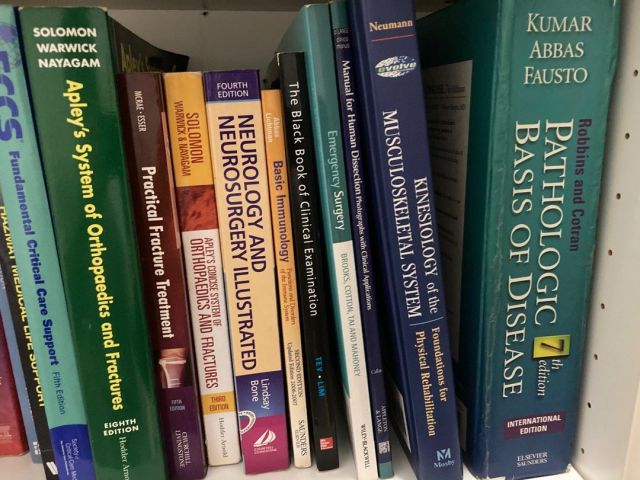
Used medical texts
Image Carousell.sg
An article in Inside higher ed, an American newsletter on current issues in higher education, reported that students are increasingly reading YouTube, podcasts and summaries generated by AI, instead of reading the literature assigned to them by their professors (Alonso, 2024). Students have been taking shortcuts since the beginning of time. They have different learning styles. Maybe a YouTube video is a better preparation than the surgeon’s big fat manuals for doing a gastroscopy or repairing a torn retina? Next time you visit your doctor, have a look at her/his bookshelf. Do the books look comfortably middle-aged, or do they seem to be in mint condition, looking as if they have not yet been opened? But either way, how to interpret this?
References
Gerasimidou, D., Bolt, N., Rakočević Uvodić, M., Siebens, A., & Okerson, A. (2024). IFLA Guidelines for Libraries Supporting Displaced Persons: Refugees | Migrants | Immigrants | Asylum seekers. IFLA. https://repository.ifla.org/handle/20.500.14598/3696
Merga, M. K., & Mat Roni, S. (2025). School library professionals’ perspectives on current and future workforce challenges. Journal of Librarianship and Information Science, 09610006241309104. https://doi.org/10.1177/09610006241309104
Tessler, M. H., Bakker, M. A., Jarrett, D., Sheahan, H., Chadwick, M. J., Koster, R., Evans, G., Campbell-Gillingham, L., Collins, T., Parkes, D. C., Botvinick, M., & Summerfield, C. (2024). AI can help humans find common ground in democratic deliberation. Science, 386(6719), eadq2852. https://doi.org/10.1126/science.adq2852
Thomas, F., & Peckham, T. (2024, January 2). A Winning case: Library partners with housing court to bring kiosks to residents experiencing housing issues. American Libraries Magazine. https://americanlibrariesmagazine.org/?p=141510
Tsvetkova, M., Yasseri, T., Pescetelli, N., & Werner, T. (2024). A new sociology of humans and machines. Nature Human Behaviour, 8(10), 1864–1876. https://doi.org/10.1038/s41562-024-02001-8
United Nations Human Rights Office. (2024, April 18). UN experts deeply concerned over “scholasticide” in Gaza. United Nations. https://www.ohchr.org/en/press-releases/2024/04/un-experts-deeply-concerned-over-scholasticide-gaza
van Melik, R., & Hazeleger, M. (2024). Routinised practices of community librarians: Daily struggles of Dutch public libraries to be(come) social infrastructures. Journal of Librarianship and Information Science, 56(2), 501–513. https://doi.org/10.1177/09610006221149203


 Peter Johan Lor
Peter: You mention that the Will Rogers Ranch Museum burned in the latest Los Angeles fire. As a native Oklahoman, I have always meant to visit – but did not. Sigh. I hope they rebuild it.