
A recent blog post, Two Ariadne threads through the bibliographic labyrinth, by Katherine McCook, evokes the myth of Ariadne’s thread, which helped Theseus find his way back out after he had entered the labyrinth of Ariadne’s father, King Minos, and killed the ferocious half-man half-bull Minotaur. (The story is told in different versions, but did not turn out happily for poor Ariadne.)
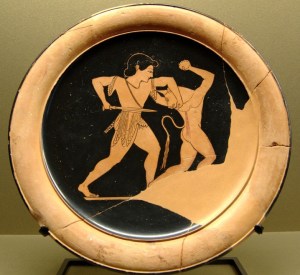
Theseus and the Minotaur
Today we have email and social media threads. Often the latter lead us to spend a lot of time looking at interesting things we did not really need to see. The thread metaphor can also refer to a series of events or artefacts, where we risk losing the connection between them. When that happens, we may lose significant contributions to our heritage. In her blog post, McCook shows how, in our reliance on digital media and neglect of printed sources, we may lose important links. The labyrinth to which she refers is bibliographic. It concerns two lecture series on bibliography and the history of the book, the Sanders Readership in Bibliography, and the Lyall Readership in Bibliography. This may appear a rather esoteric field, but she gives a master class in researching Wikipedia entries and creating the many links that make the Wikipedia a coherent, many-threaded resource. Along the way she gives an interesting account of how, from the fifteenth century, scholars have tried to bring order to the exponentially growing output of the printing press, that “horrible mass of books”, as Gottfried Wilhelm Leibnitz (a polymath and early library theoretician) called it in 1680. Encyclopaedism, Antonio Panizzi, Paul Otlet, the Mundaneum and WorldCat and the Wikipedia feature in the story, with many useful references.


 Peter Johan Lor