
This column of news, views and snippets from the international literature of books, libraries, and information, was written in March 2025 and appeared the June 2025 issue of LIASA-in-Touch, the quarterly newsletter of the Library and Information Association of South Africa.
Fire or ice?
Recent events in the world of information and libraries have brought to mind a poem by Robert Frost, entitled “Fire and Ice”:
Some say the world will end in fire,
Some say in ice.
From what I’ve tasted of desire
I hold with those who favor fire.
But if it had to perish twice,
I think I know enough of hate
To say that for destruction ice
Is also great
And would suffice.
© 1923, Robert Frost, “Fire and ice”, from New Hampshire.
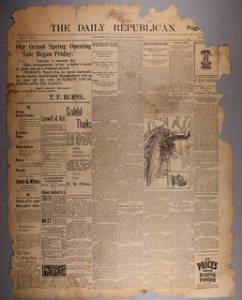
Acid newsprint paper crumbling and flaking
In previous columns (Global Gleanings #22 and #23) I referred to the destruction oflibraries in Ukraine, California and Gaza. When wildfires and fires caused by human agency destroy libraries spectacularly, they sometimes attract media attention – at least for a day or two. Other fires are slow and certain, destroying libraries and heritage almost unnoticed on a far larger scale. Slow fires: on the preservation of the human record was the title of a 1987 documentary film by Terry Sanders in which he drew attention to the ongoing loss of library holdings due to the breakdown of acidic paper. Slow fires are still burning in libraries and archives all over the world.
So much for fire; now about ice.
Although a digital copy can never quite replace the original, if heritage materials are digitised, the chances of unique items being irremediably lost are reduced. At any given moment thousands of digitisation projects must be under way all over the world, some on a very large scale, such as those of Google, Gallica and Europeana.
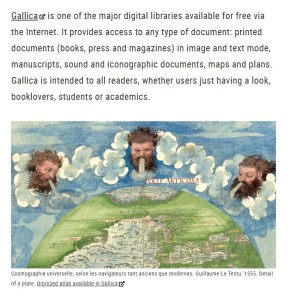
A digitised atlas available from Gallica
A Wikipedia page listing over two hundred “digital library projects” illustrates the wide range of subjects, languages, genres and materials being covered. Innovative technology, using machine learning and artificial intelligence is helping us to rapidly digitise difficult materials such as handwritten texts with a high degree of accuracy (Nockels, Gooding, and Terras 2024). But is digitisation the answer? Not unless we exercise constant vigilance, as is clear from an article by Christina Nguyen (2024), who exposes the “illusion of invulnerability” of digital archives and repositories, which may be threatened by malicious attacks and cyber-warfare.
This also applies to contemporary born-digital content, the heritage material of the future. In an article about the Internet Archive, Stokel-Watson (2024) stated that “a quarter of all web pages that existed at some point between 2013 and 2023 now don’t”. When links are found to be broken, finding these items at new addresses is time-consuming and not always successful. This often happens when organisations revamp their websites. I found, for example, in the case of the European Union, that when funded projects are completed and the grant funding is depleted, their web pages simply disappear.
Vulnerability of digital data
Web pages can be made to disappear. In the U.S.A. the new administration is on a mission to put a stop to all “radical and wasteful government DEI [diversity, equality and inclusion] programs”, which, according to a statement from the White House, demonstrated “immense public waste and shameful discrimination”. Scrambling to comply with the administration’s directives by the given deadlines, federal agencies and institutions such as universities receiving federal funding, rapidly compiled lists of words and images that may not appear on their websites. These included words such as ‘biases’, ‘racism’, ‘gender’ and ‘women’ (Weissman 2025). The Arlington National Cemetery (a military-run facility) quickly stripped content relating to notable black, Hispanic and female veterans from its site – but may reinstate some of them later, when there is more time and clarity (Drenon 2025).
After the US election in November 2016, a website called the “Silencing Science Tracker” was set up to monitor “government attempts to restrict or prohibit scientific research, education or discussion, or the publication or use of scientific information”.
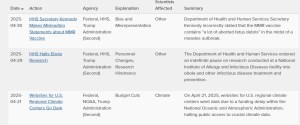
Excerpt from table compiled by Silencing Science Tracker
https://climate.law.columbia.edu/Silencing-Science-Tracker
Entries on its list since January 2025 show a spurt of activity by state and federal agencies seeking to censor and terminate research on climate change, wildlife, education, and health issues that are unpalatable to the new administration. For example, the Centers for Disease Control ordered its scientists to retract or pause publication of any research findings that mention “forbidden terms” relating to gender and sexuality. By mid-March 2025 “more than a hundred and ten thousand government pages have gone dark”. In anticipation of this, volunteer librarians and archivists set up the Data Rescue Project to coordinate their efforts to download government data before it disappears (Lucas 2025; Quinn 2025). The stakes are high: “Data suppression or alteration poses serious risks to various sectors and populations. Without access to accurate data, climate science, immigration, education, and the economy could be adversely affected” (Laney 2024). Maybe the reforming zeal of the Trump administration and its threat to research will fade. In the meantime, librarians have a long-term responsibility to help preserve the records of science and scholarship.
Tailpiece
To end on a warmer note, here’s an interesting snippet from Radio Station WUWM 89.7 FM in Milwaukee, Wisconsin, the radio station my wife and I used to listen to when we lived in Milwaukee. It is affiliated to the non-commercial National Public Radio (NPR) network. (At time of writing, Mr Trump was urging Republic
Silent book club readers in Milwaukeeans in Congress to defund NPR.) This insert is about “silent book clubs”, where members get together about once a month in a coffee shop or craft beer brewery to read their books. Each person reads

a book of his/her own choice. For an hour or so they read silently, after which they turn to other readers and chat about what they are reading, and generally socialise (Nuñes and Silver 2025). Maybe something our libraries could host – provided we can serve decent coffee, if not craft beer!
References
Drenon, Brandon. 2025. “Arlington Cemetery Strips Content on Black and Female Veterans from Website.” BBC. March 15, 2025. https://www.bbc.com/news/articles/cz03gjnxe25o.
Laney, Douglas B. 2024. “Safeguarding Against A Trump Data Dump.” Forbes. November 21, 2024. https://www.forbes.com/sites/douglaslaney/2024/11/21/safeguarding-against-another-trump-data-dump/.
Lucas, Julian. 2025. “The Volunteer Data Hoarders Resisting Trump’s Purge.” The New Yorker, March 14, 2025. https://www.newyorker.com/news/the-lede/the-data-hoarders-resisting-trumps-purge.
Nguyen, Christina Dinh. 2024. “Digital Cultural Heritage in the Crossfire of Conflict: Cyber Threats and Cybersecurity Perspectives.” Insights the UKSG Journal 37 (May):7. https://doi.org/10.1629/uksg.647.
Nockels, Joseph, Paul Gooding, and Melissa Terras. 2024. “The Implications of Handwritten Text Recognition for Accessing the Past at Scale.” Journal of Documentation 80 (7): 148–67. https://doi.org/10.1108/JD-09-2023-0183.
Nuñes, Xcaret, and Maayan Silver. 2025. “Are You a Reader Who Likes Meeting New People? Try Milwaukee’s Silent Book Club!” WUWM 89.7 FM – Milwaukee’s NPR. January 14, 2025. https://www.wuwm.com/2025-01-14/are-you-a-reader-who-likes-meeting-new-people-try-milwaukees-silent-book-club.
Quinn, Ryan. 2025. “As Data Goes Off-Line Under Trump, Environmental Researchers Are Uploading Backups.” Inside Higher Ed (blog). January 29, 2025. https://www.insidehighered.com/news/faculty-issues/research/2025/01/29/data-goes-line-under-trump-researchers-upload-backups.
Stokel-Walker, Chris. 2024. “We’re Losing Our Digital History. Can the Internet Archive Save It?” BBC. September 16, 2024. https://www.bbc.com/future/article/20240912-the-archivists-battling-to-save-the-internet.
Weissman, Sara. 2025. “Colleges Flag Words Like ‘Women’ to Comply With DEI Bans.” Inside Higher Ed (blog). March 17, 2025. https://www.insidehighered.com/news/diversity/race-ethnicity/2025/03/17/colleges-flag-words-women-comply-dei-bans.
Postscript
Since this was written, the MAGA (‘Make America Great Again’) wrecking ball is continuing to wreak havoc on American science and scholarship. Some examples:
- By an executive order, President Trump has directed Vice-President Vance to “eliminate improper, divisive, or anti-American ideology” from the museums, centres and the National Zoo of the Smithsonian Institution, Washington.
- Ivy League universities (eight prestigious private universities in the north-east of the USA) are being subjected to a massive attack on intellectual freedom, on the pretext that they are tolerating antisemitism and pursuing a “woke” DEI agenda. As leading research institutions, they rely on large government research grants, which are now being cut. Reduction of research resources will have negative impacts on their libraries.
- Harvard University, currently ranked third in the world after Oxford and Massachusetts Institute of Technology, has been singled out. The Trump administration has revoked Harvard’s participation in the Student Exchange and Visitor Program. This means that ‘international’ (i.e. foreign) students no longer have official documents needed for visas allowing them to study in the USA. This affects over one quarter of the student body. The affected students have to find other universities that will take them, or leave the USA without completing their studies. Harvard is challenging this in the courts.
- President Trump issued an executive order dismantling the Institute of Museum and Library Services. It is among one of seven federal agencies that are to be “eliminated to the maximum extent of the law”. They were ordered to reduce their staff and services. The Office of Management and Budget was also ordered to reject any budget requests from the seven agencies other than funds needed to shut them down. At the same time President Trump appointed the Deputy Secretary of the Department of Labor, Keith E. Sonderling, as Acting Director of the IMLS. Mr Sonderling, a lawyer, has stated that he intends “steering this organization in lockstep with this Administration to enhance efficiency and foster innovation. We will revitalize IMLS and restore focus on patriotism, ensuring we preserve our country’s core values, promote American exceptionalism and cultivate love of country in future generations”.
- In the original version of this column I mentioned that President Trump was urging Republicans legislators to defund National Public Radio. On 2 May he issued an executive order to this effect.
I find it difficult to grasp how these actions will “make America great again.”


 Peter Johan Lor