
This column of news, views and snippets from the international literature of books, libraries, and information, was written in September 2025 and appeared the December 2025 issue of LIASA-in-Touch, the quarterly newsletter of the Library and Information Association of South Africa.
Bugs and bad actors
When I was in library school in the 1960s, there was a lot of very practical instruction, which is frowned upon nowadays. Our syllabus included such matters as the dimensions of library furniture, and the care of collections. We were taught about various enemies of books that had to be combated. They come in all shapes and sizes. One of the smaller “pests” is the “drugstore” or bread beetle, Stegobium paniceum, a small brown beetle about 3 mm long.
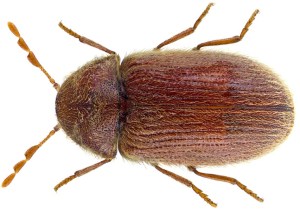
Bread Bug (Stegobium paniceum)
It may be found in stored foodstuffs like grains and flour, bread, coffee beans, seeds, and dried fruit. It also likes paper and leather bindings, especially the glues used to put them together. Recently it was reported that Hungary’s oldest library, the library of the Pannonhalma Archabbey, founded in 996 AD, is infested by this bug. They are eating their way through the oldest collection of books in Hungary (Associated Press 2025). Read the article to see the damage the beetles are causing and the measures being taken.
Bug infestation are not nearly as spectacular as the daring robbery in Paris on 19 October when priceless jewels were stolen from the Louvre. Book thefts are more pedestrian, but can be devastating too, since the thieves do their research – online catalogues are very useful to them – before they strike, and go for carefully selected items. Fortunately, the thieves do get caught from time to time. An organised group of crooks based in Georgia (Europe) stole rare books in Russian from national and university libraries in various European countries. Posing as researchers, they borrowed them and returned high quality copies instead of the originals. With the help of Europol, a hundred police officers were deployed in Georgia and Latvia in a coordinated raid. They seized 150 books valued at $2,8 million, and apprehended seven suspects (Stillman 2025).
Books are not broken up as often as jewellery, but books containing rare maps and beautiful plates are. When I pass the shop window of an antiquarian bookshop in which old maps are displayed, I can’t help feeling suspicious. In any case, an antique atlas, an Audubon or a Levaillant should not be broken up, even by the legitimate owner. In terms of heritage the whole is more valuable than its parts, even if they may be more profitable to sell.
Citizen science and libraries
There is growing interest in the role of libraries in supporting citizen science. A systematic review of citizen science in libraries (Mumelaš et al. 2025) covers the various ways in which libraries can serve as facilitators and hubs for community engagement, and highlight many practical examples. A Spanish study has analysed the involvement of both university and public libraries, concluding that library participation is still limited (Silva-Aboy and Martin-Melon 2025).
SABAP2 logo
In retirement, I’m a citizen scientist too, contributing regularly to the Southern African Bird Atlas Project 2 (SABAP2) and to semi-annual surveys of wetland birds and large terrestrial birds. From my perspective I would like to see more user research of an ethnographic nature into what actually happens in the field and what information needs citizen scientists bring to their libraries – if they do.
Library systems
I was never a cataloguer, although as a library director, I sometimes found cataloguers a bit trying, mainly because they were unwilling to compromise on the rules and standards they had to apply. One has to respect that. This was more than two decades ago, and in the meantime cataloguing, it seems, has been supplanted (or sublimated) by resource discovery – systems and processes enabling users to efficiently find a very wide range of resources both within the library and without.

Consulting an OPAC (Image: LibraryWorld, https://opac.libraryworld.com/)
A recent article about a university library’s programme to rationalise systems and make things easier for users was insightful (Dragon et al. 2025). It helped me to understand why I quite often struggle to find resources using my university library’s website, and it increased my respect for the library professionals who have to deploy and coordinate a whole panoply of systems to make resources discoverable – altogether a more complex task than users imagine. Don’t let anyone tell you that cataloguers are no longer needed.
AI
Maybe AI can help with that. A study at a university library in Lucknow, India, investigated the interaction among Online Public Access Catalogs (OPACs), electronic resources and Large Language Models (LLMs) and investigated the effect of these tools on resource usage and academic behaviour (Shimray et al. 2025). The authors reported declining use of the OPAC (which is not unusual) and a preference for e-resources and LLMs. The latter were used for summarization, analysis and academic writing. I find the latter a bit alarming, but things are changing all around us. AI is having an impact everywhere.
In a recent issue of Digital library perspectives, Anna Maria Tammaro interviewed Getaneh Alemu, Cataloguing and Metadata Librarian at Southampton Solent University, and an expert in this field, about his research and experimentation at the “artificial intelligence frontier” in library cataloguing and metadata work (Alemu and Tammaro 2025). Cataloguers may take some comfort in his prediction that technology will not replace them, but serve as a “catalyst for efficiency, enrichment and improved discovery”. As a matter of interest, I was pointed to this article by Google’s “AI Overview”, which included quite a long list of AI applications in cataloguing and metadata.
More generally, we may expect some far more disruptive impacts of AI in our daily lives. We now take the World-wide Web for granted, but a post on the BBC’s Future site poses the question, “Is Google about to destroy the web?” (Germain 2025). Google is adding more AI to its search engine, and is introducing a new “AI Mode” which is much more powerful than the “AI Overview” I mentioned above. This may fundamentally change the business model of the Web. When people use Google, Google directs them to sites where they can find (some of) the information they are looking for. But if Google’s AI provides us with what appears to be all the information we need, why click through to the websites of publishers and other information providers? Fewer clicks, less business. Some publishers are thinking of abandoning the Web and moving to social media platforms.
But let’s rather worry about something closer to home: the stereotyping of librarians in visual images created by ChatGPT (Spennemann and Oddone 2025). Most of us will have been annoyed by stereotyped portrayals of librarians in magazine articles, TV programmes, and movies: always the middle-aged, shushing woman wearing sensible shoes, with her grey hair in a bun.

Stereotyped librarian (Image generated by Google Gemini)
The researchers looked into the presence of bias in images of librarians created by ChatGPT. They prompted ChatGPT to create visualisations of librarians in various settings, and then analysed the images in terms of gender, ethnicity, age, attire and hairstyles. They also looked at the depiction of the library interiors in which the images were placed. They found significant evidence of bias. In academic libraries white males were heavily overrepresented. Only six percent of academic librarians were female. Uncritical use of images generated by AI can perpetuate stereotypes.
Christmas story
For our tailpiece this month I turned to the Good News Network. I cannot resist including a somewhat older item about a then 8-year-old boy by the name of Dillon Helbig. He is an aspiring author who snuck his own handwritten book, The Adventures of Dillon Helbig’s Crismis (81 pages, with his own illustrations) between some other picture books in his local library.
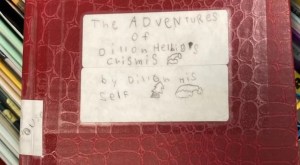
Cover of book written by then eight-year-old Dillon Helbig
The library staff found it there, liked it, added it the collection and catalogued it. It became so popular that it had a long waiting list. Readers have to wait because only one copy exists, and interlibrary loan requests cannot be filled. (Cole 2022).
References
Alemu, Getaneh, and Anna Maria Tammaro. 2025. “Navigating the Artificial Intelligence Frontier on Cataloguing and Metadata Work in Libraries: An Interview with Getaneh Alemu.” Digital Library Perspectives 41 (3): 587–92. https://doi.org/10.1108/DLP-08-2025-208.
Associated Press. 2025. “Hungary’s Oldest Library Is Fighting to Save 100,000 Books from a Beetle Infestation.” CNN, July 14. https://www.cnn.com/2025/07/14/europe/hungary-library-beetle-infestation-intl-hnk.
Cole, Judy. 2022. “8-Year-Old Slips his Handwritten Book onto a Library Shelf—And it now has a Years-Long Waitlist.” Good News Network, February 9. https://www.goodnewsnetwork.org/dillon-helbig-library-book-boise-idaho/.
Dragon, Patricia M., Janet L. Mayo, Ann Carol Stocks, and Rebecca Tatterson. 2025. “Enhancing Library Discovery: An Approach to Understanding User Access to Electronic Resources.” The Journal of Academic Librarianship 51 (4): 103064. https://doi.org/10.1016/j.acalib.2025.103064.
Germain, Thomas. 2025. “Is Google about to Destroy the Web?” BBC Future, June 13. https://www.bbc.com/future/article/20250611-ai-mode-is-google-about-to-change-the-internet-forever.
Mumelaš, Dolores, Ivana Matijević, and Tomislav Ivanjko. 2025. “Citizen Science in Libraries Worldwide: A Systematic Review.” Journal of Librarianship and Information Science, June 26, 09610006251342825. https://doi.org/10.1177/09610006251342825.
Shimray, Somipam R., A. Subaveerapandiyan, and Naved Ahmad. 2025. “Digital Transformation in Academic Libraries: E-Resources, OPACs and AI in Information Discovery.” Reference Services Review, 1–18. https://doi.org/10.1108/RSR-12-2024-0078.
Silva-Aboy, Maria, and Roberto Martin-Melon. 2025. “The Participation of Spanish Libraries in Citizen Science: An Analysis of Their Role and Involvement.” Information Development, September 8. https://journals.sagepub.com/doi/abs/10.1177/02666669251375483.
Spennemann, Dirk HR, and Kay Oddone. 2025. “What Do Librarians Look like? Stereotyping of a Profession by Generative Ai.” Journal of Librarianship and Information Science, August 16. https://journals.sagepub.com/doi/full/10.1177/09610006251357286.
Stillman, Michael. 2025. “Two More Arrests Made in European Library Thefts.” Rare Book Monthly, February. https://www.rarebookhub.com/articles/3793.


 Peter Johan Lor