
Global Gleanings #27 Literacy
This column of news, views and snippets from the international literature of books, libraries, and information, was written in March 2025 and appeared the June 2025 issue of LIASA-in-Touch, the quarterly newsletter of the Library and Information Association of South Africa.
Hifalutin literacy
In an attempt to contribute to the issue theme of literacy, I combed through my database for recent material on libraries and literacy. The current literature of LIS is awash with articles, blogs, and web pages dealing with multiple overlapping types of literacy. Here are some, in alphabetical order, as it behoves librarians: AI literacy, the most recent type (e.g. Hossain 2024), computer literacy (now dated; see Ovens 1991), digital literacy (e.g. Bélanger 2026), information literacy (there’s a journal devoted to it, the Journal of Information Literacy, where I found Matteson and Gersch 2020), media literacy (e.g. Park et al. 2023), visual literacy (e.g. Brown et al. 2016), and more. The 2024 IFLA Trend Report (Dezuanni and Osman 2024) frequently mentions various advanced forms of literacy. It also refers to UNESCO’s International Literacy Day (in September every year). That UNESCO page offers various resources on literacy.
The IFLA Trend Report has little to say about basic literacy, as in reading and writing. Neither does that feature much elsewhere in our recent literature. I daresay that this has been the case during much of my professional career. The closest we librarians have come to basic literacy seems to have been the provision of space, programming and suitable reading material for children learning to read and for clients enrolled in adult literacy programmes, with a focus on establishing a love of books and reading. As a profession we have steered clear of teaching the foundational competence required for all literacies: reading and writing. (I may be wrong; if I am, do let me know.)
IMHO there are reasons for this. One is that the teaching profession does not like amateurs getting involved in teaching people to read and write.

Learning to read. From UNESCO website: https://www.unesco.org/en/days/literacy; Credit Anca Milushev/Shutterstock.com
A fictional example is found in that acclaimed and controversial book, To kill a mockingbird, by Harper Lee (Lee [1960] 2026). The central character, a little girl nicknamed Scout, goes to school for the first time and horrifies her teacher when it is discovered that she already knows how to read. In fact, the teacher seems to regard this is an insult to her profession, and is quite nasty to poor Scout.
Another reason is that there are complicated and competing theories about the teaching of reading. A cynic would say that this is part of professional mystification. If you make something difficult to understand, you can keep a monopoly of it and enhance your professional prestige (Posner 1998).
Plain, unvarnished reading and writing
In South Africa we are rightly alarmed about the inability of so many learners to read and understand even simple text (Kitchen 2025). This is also reflected in our professional journal, the South African Journal of Libraries and Information Science (Mojapelo 2023). Without the old-fashioned foundational reading and writing skills, the advanced forms of literacy are mostly unattainable for our learners.
It is worth noting that literacy features in the most recent IFLA-UNESCO Public Library Manifesto (Krass et al. 2022) as the fourth of eleven key missions of the public library:
- Initiating, supporting and participating in literacy activities and programmes to build reading and writing skills, and facilitating the development of media and information literacy and digital literacy skills for all people at all ages, in the spirit of equipping an informed, democratic society (p.2)
Here at least, basic literacy, is placed in the foreground. So, what are libraries doing about it?
An answer may be sought in a report on a survey of Australian public library mission statements (Hider and Coe 2025). The authors checked to what extent they reflected the IFLA–UNESCO Public Library Manifesto. They found that Mission 4 was covered in only eight (16%) of the 50 public library mission statements they examined. These at least all referred to basic literacy, but half of them also referred to digital literacy (which, I suppose, is much more “sexy”.) It may be that the literacy level in Australia is much higher than here, so that teaching basic literacy does not arise as an important issue in a library context.
Decoding books?
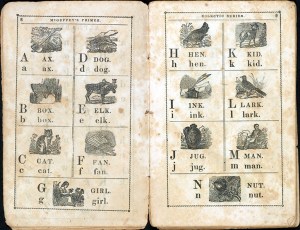
On the fringes of the LIS literature, on promotional websites of various non-profit organisations and commercial suppliers, I discovered a term new to me: “decodable books”. An American non-profit called Teach My Kid to Read with the mission to “bridge the gap with libraries and communities”, has since 2019 been working “to educate public librarians about the process of learning to read and how decodable books support skilled reading”. Decodable books are part of a structured, phonics-based approach intended to help children decode what is on the printed page. Phonics means sounding out words, connecting letters of the alphabet to sounds, and then building on this skill to decipher new words. That’s the way my mother taught me to read before I went to school. (She didn’t know that this was naughty.) In any case, that was how the teachers then taught too. But when my children went to school, educators preferred the “whole language” or “look and say” method, in which learners learned to recognize and remember whole words, often in illustrated reading books. The illustrations have a disadvantage: some children remember the pictures, guess the word, and never learn to read. For more than a century there has been fierce debate about the respective advantages and disadvantages of the two methods. This is much more complicated than I can cover here. Wikipedia has a good explanation. For us, and particularly public librarians, it is useful to be aware of the enormous literacy challenge our country faces, and to learn how we can mobilise various kinds of learning resources for our young beginning readers.
I leave the question in your midst, dear readers: what is your library doing to address our crisis of basic literacy?
McGuffey’s primer, 1836 Image Wikipedia, https://en.wikipedia.org/wiki/Phonics
References
Bélanger, Annie. 2026. “In Support of the Continued Role of Libraries in Digital Literacy.” The International Information & Library Review 0 (0): 1–9. https://doi.org/10.1080/10572317.2026.2614244.
Brown, Nicole E., Kaila Bussert, Denise Hattwig, and Ann Medaille. 2016. Visual Literacy for Libraries: A Practical, Standards-Based Guide. ALA editions, an imprint of the American Library Association.
Dezuanni, Michael, and Kim Osman. 2024. IFLA Trend Report 2024. Digital Media Research Centre. https://www.ifla.org/wp-content/uploads/ifla-trend-report-2024.pdf.
Hider, Philip, and Mary Coe. 2025. “Australian Public Library Mission Statements and the IFLA–UNESCO Public Library Manifesto.” IFLA Journal, December 9, 03400352251399851. https://doi.org/10.1177/03400352251399851.
Hossain, Zakir. 2024. “School Librarians Developing AI Literacy for an AI-Driven Future: Leveraging the AI Citizenship Framework with Scope and Sequence.” Library Hi Tech News 42 (2): 17–21. https://doi.org/10.1108/LHTN-10-2024-0186.
Kitchen, Tracy. 2025. “South African Learners Struggle with Reading Comprehension: Study Reveals a Gap between Policy and Classroom Practice.” The Conversation, August 4. https://doi.org/10.64628/AAJ.udjyqa3a6.
Krass, Ulrike, Margaret Allen, Elizabeth White, et al. 2022. “The IFLA-UNESCO Public Library Manifesto 2022.” July 27. https://repository.ifla.org/handle/20.500.14598/2006.
Lee, Harper. (1960) 2026. To Kill a Mockingbird. J.B. Lippincott. https://en.wikipedia.org/w/index.php?title=To_Kill_a_Mockingbird&oldid=1331906274.
Matteson, Miriam Louise, and Beate Gersch. 2020. “Information Literacy Instruction in Public Libraries.” Journal of Information Literacy 14 (2). https://doi.org/10.11645/14.2.2680.
Mojapelo, Samuel Maredi. 2023. “Whopping Low Reading Literacies in South Africa:” South African Journal of Libraries and Information Science 89 (1): 1–14.
Ovens, Cora S.H. 1991. “Computer Literacy and Libraries.” The Electronic Library 9 (2): 85–89. https://doi.org/10.1108/eb045045.
Park, Sora, Barbara Walsh, and Jing Su. 2023. Libraries and Media Literacy Education. News and Media Research Centre. https://doi.org/10.25916/KAHM-ZR94.
Posner, Richard A. 1998. “Professionalisms.” Arizona Law Review 40. https://chicagounbound.uchicago.edu/cgi/viewcontent.cgi?article=2910&context=journal_articles.


 Peter Johan Lor