
I’m delighted to share that the IFLA Library History Special Interest Group has organized a Satellite Conference to be held from 17 to 19 August, in Mons, Belgium. The Satellite Conference will immediately precede IFLA’s 2023 World Library and Information Conference (WLIC), which will be held in Rotterdam, the Netherlands, from 20 to 24 August.
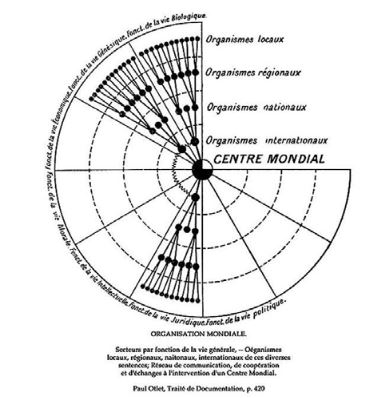
Worldwide organization of knowledge, diagram by Paul Otlet
The theme of the Satellite Conference is “Preserving our origins: Approaches to the organization, curation, and historiography of the record of national and international organizations in libraries, information, and documentation.” It has two aims: (1) to build on our understanding of the state of preservation and accessibility of historical sources for the historiography of library information sciences (LIS) and information science and technology organizations; and (2) to further explore the history of these organizations from their origins in the late 19th and early 20th century to today.
Attention will be paid to digitization and curation programs as well as accounts that focus both on organizational history and the associated primary sources that serve as the basis of this research, including selected topics in the history of LIS and documentation organizations in preparation for the celebration of IFLA’s centenary in 2027. For more on the event, see the Satellite Conference webpage.
The Mundaneum
The event is organized in collaboration with the Mundaneum, in the city of Mons. The Mundaneum has a fascinating history, which goes back to an initiative taken by two Belgian lawyers, Paul Otlet, the founding father of the discipline of Documentation (an ancestor of Information Science) and Henri La Fontaine, a Belgian senator and Nobel peace prize laureate, in 1895. Both men were deeply committed to an idealistic striving for world peace, and believed that universal access to knowledge provided a pathway to it. They started the Repertoire Bibliographique Universel, a catalogue of the world’s scientific literature on 3×5 inch index cards, which eventually amounted to over twelve million cards. It was organized using the Universal Decimal Classification (UDC). a classification scheme they adapted from Melvil Dewey’s Decimal Classification. The UDC is still used today and is kept up to date by the international UDC Consortium. The Repertoire and various other collections and archives were housed in the Palais Mondial (World Palace) in Brussels. It was later renamed the Mundaneum. Following World War II, the Mundaneum was neglected, but it was later relocated to the city of Mons, in Wallonia, the French-speaking region of Belgium. Here it has been designated as the Mundaneum-Centre d’archives de la Fédération Wallonie-Bruxelles (Mundaneum-Archive Centre of the French Community of Wallonia-Brussel). It serves as a museum and archives, with exhibition and conference facilities. I’m looking forward enormously to attending the Satellite Conference in the Mundaneum and seeing the Répertoire and other collections for myself.
Paul Otlet
The presence of Paul Otlet will undoubtedly be felt when we visit the Mundaneum. He was a significant figure in the early Twentieth Century history of our profession. His book Traité de documentation: le livre sur le livre, théorie et pratique (Otlet 1934) is regarded as a milestone in documentation/information science and librarianship and more generally, in the intellectual history of the West. Together with his other writings, it heralded a paradigm shift in our thinking about information, much as Ferdinand de Saussure did for linguistics and semiotics.
Our keynote speaker: W. Boyd Rayward
Few scholars have written more insightfully about the evolution of our concepts of information, the quest for universal access to knowledge, and the development of international bibliographic control, than W. Boyd Rayward (e.g. Rayward 1981; 1996; 1997; 2012). My personal Zotero database lists over thirty of his writings, twelve of which I cited in my book (Lor 2019a). Rayward has written specifically about Otlet’s contribution (e.g. Rayward 1991; 2003), and produced a translated and adapted version of a publication about the Mundaneum (Rayward 2010), which is available online and worth reading before a visit. His writings have fired my own interest in the history of libraries in the Belle Époque (roughly 1870 to 1914), in particular, in what librarians were doing while Otlet was inventing documentation (Lor 2019b). The Library History SIG is therefore delighted that Professor Rayward has agreed to present the keynote address at the Satellite Conference. For a curriculum vitae and list of his publications, see D’Arpa (2013) and for an assessment of his wide influence, see Buckland and Lund (2013). I’m looking forward to meeting him in person.
Postscript: Here is a very recent blog post about the Mundaneum, “Mundaneum: Machine to Think the World”: A New Permanent Exhibition”, by Jacques Gillen.
References
Buckland, Michael Keeble, and Niels W. Lund. 2013. “Boyd Rayward, Documentation, and Information Science.” Library Trends 62 (2): 302–10. https://doi.org/10.1353/lib.2013.0038.
D’Arpa, Christine. 2013. “W. Boyd Rayward: Curriculum Vitae.” Library Trends 62 (2): 265–81. https://doi.org/10.1353/lib.2013.0046.
Lor, Peter Johan. 2019a. International and Comparative Librarianship: Concepts and Methods for Global Studies. Global Studies in Libraries and Information 4. Berlin; Boston: De Gruyter/Saur.
———. 2019b. “What Were Librarians Doing While Otlet Was Inventing Documentation? The Modernization and Professionalization of Librarianship during the Belle Époque.” JLIS.It, Italian Journal of Library and Information Science 10 (3): 133–47. https://doi.org/10.4403/jlis.it-12566.
Otlet, Paul. 1934. Traité de documentation: le livre sur le livre, théorie et pratique. Palais mondial.
Rayward, W. Boyd. 1981. “The Evolution of an International Library and Bibliographic Community.” Journal of Library History 16 (2): 449-462.
———. 1991. “The Case of Paul Otlet, Pioneer of Information Science, Internationalist, Visionary: Reflections on Biography.” Journal of Librarianship and Information Science 23 (3): 135–45. https://doi.org/10.1177/096100069102300303.
———. 1996. “The History and Historiography of Information Science: Some Reflections.” Information Processing & Management 32 (1): 3–17. https://doi.org/10.1016/0306-4573(95)00046-J.
———. 1997. “The Origins of Information Science and the International Institute of Bibliography/International Federation for Information and Documentation.” Journal of the American Society for Information Science 48 (4): 289–300.
———. 2003. “Knowledge Organisation and a New World Polity: The Rise and Fall and Rise of the Ideas of Paul Otlet.” Transnational Associations, no. 1 & 2: 4–15.
———. 2010. Mundaneum: Archives of Knowledge. Ocasional Papers 215. Urbana IL: Graduate School of Library and Information Science, University of Illinois at Urbana-Champaign. https://core.ac.uk/reader/4824310.
———. 2012. “The Search for Universal Access to Information: From the Office of Publick Addresse to the World Wide Web: And Beyond?” In A Belt around the World: A World Building on Education, Lifelong Learning and Technology: A Festschrift Honoring Nasser Sharify, edited by John Southard and W. David Penniman, 190–211. Nasser Sharify Foundation Publication Series. Bloomington IN: iUniverse.


 Peter Johan Lor