
The 1970s saw the publication of several noteworthy contributions to the theory and methodology of comparative librarianship. The first was Simsova and MacKee’s (1970) Handbook of comparative librarianship, a pioneering but ultimately disappointing work, of which a revised edition followed in 1975 (Simsova and MacKee 1975). I call it ‘disappointing’ because barely seventy of its 548 pages, “Part 1, Comparative librarianship and comparative method”, dealt with theory and methodology, and that rather superficially. Simsova was strongly influenced by pioneers of comparative education such as George Z.F Bereday (1964) and followed his rather mechanistic approach to comparisons between countries. The remaining 460 pages of the book is devoted to an eclectic “Guide to sources”, contributed by MacKee, and organized mainly by country. Nevertheless, this book was influential in stimulating international and comparative librarianship studies in the United Kingdom.
The second work that should be mentioned is an entry on “Comparative Librarianship” by Dorothy Collings in the Encyclopedia of library and information science (Collings 1971). Collings pioneered the teaching of the subject in the USA, where she taught it as Columbia University from 1956-1971. For her course she had developed an “Outline for the study of a foreign library system”, which was later reprinted by Simsova (1982). This inventory is still useful, albeit very outdated. After Columbia she returned to Jamaica, where she established a library science course at the University of the West Indies. Her career and influence have been discussed by Jackson (2001).

Joseph Periam Danton (1908-2002) (C) Guggenheim Foundation
Having missed the anniversaries of these two pioneering works, I come to a true golden jubilee, that of J. Periam Danton’s Dimensions of comparative librarianship (Danton 1973).
Joseph Periam Danton (1908-2002) had a long and distinguished career in library education and international librarianship. The latter should be no surprise, given his educational and working background. His parents were German language educators who moved to Beijing in 1916 and stayed there for ten years. In 1924 he enrolled at Oberlin College in Ohio to study German. He spent an academic year in Leipzig, Germany, where his parents were then teaching. After graduating with a BA in German, Danton obtained a BS in Library Science at the library school of Columbia University. He then studied part-time for a master’s degree in German. In 1930 he was recruited by the ALA as secretary to its chief executive, Carl Milam, who was active in IFLA and in other international initiatives. While working at ALA headquarters in Chicago, Danton enrolled at the Graduate Library School of the University of Chicago, where he obtained his PhD in1935. After various academic positions, and a spell as a Navy intelligence officer during WW2, in 1946 he was appointed as Dean of the School of Librarianship at the University of California at Berkeley, where he stayed until he retired in 1976, when he became an emeritus professor. A more detailed biography can be found on the website of the SNA Cooperative (SNAC).
In 1949 Danton was commissioned by UNESCO to contribute a text on Education for librarianship for the series UNESCO public library manuals (Danton 1949). It was a practical manual covering various aspects of modern libraries and library schools, advocating for the location of the latter in a “strong, stable, high-standard university” (p.9). Among his many publications I note in particular his book, United States influence on Norwegian librarianship (Danton 1957), an early example of studies of international influence in librarianship, and his very thorough and scholarly comparative study, Book selection and collections: a comparison of German and American university libraries (Danton 1963).
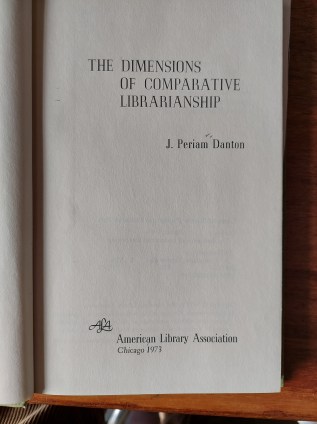
Title page of Danton’s book, The dimensions of comparative librarianship (my photo of my own well-thumbed copy)
This was sound preparation for his seminal book, The dimensions of comparative librarianship, which he wrote while he held a Guggenheim Fellowship, and which was published by the ALA in 1973 (Danton 1973). Since 1961 he had been responsible for a doctoral seminar on “Comparative Librarianship” at Berkeley, and he noted in his Preface that his “reflections on the state of the art, particularly when contrasted with other disciplines … [had led him] to an increasingly strong conviction that comparative study in librarianship is sadly deficient in a number of major respects” (p. ix). In the book he pointed out these deficiencies, which he attributed to the lack of a precise terminology, of criteria for the evaluation of published studies, and of qualified researchers.
Danton’s introductory chapter provides a thorough review of the history of international librarianship, including education in the field, before turning to the history of comparative studies in other fields. The second chapter covers the first of his four dimensions, namely the terminology, definition, and scope of comparative librarianship. Here he offers a very critical chronological review of attempts to define comparative librarianship and distinguish it from international librarianship. He pointed out that the definitions of comparative librarianship appear to have been developed without any reference to definitions of other comparative fields, such as comparative education, which he proceeded to discuss in some detail, arriving on p.52 to his own definition of comparative librarianship. Although it is not clearly flagged as a definition, he stated that comparative librarianship
…may be defined as area of scholarly investigation and research as the analysis of libraries, library systems, some aspect of librarianship, or library problems in two or more national, cultural or societal environments, in terms of socio-political, economic, cultural, ideological, and historical contexts. This analysis is for the purpose of understanding the underlying similarities and differences and for determining explanations of the differences, with the ultimate aim of trying to arrive at valid generalizations and principles (Danton 1973, 52).
This is the definition that I used in my own book (Lor 2019, 87).
In Chapter 3 Danton discusses “The dimensions of purpose and value”, again basing his conclusion on a critical chronological listing of earlier statements, and elaborating on aspects already broached in the definition, namely that the phenomena studies are considered not in isolation but in “socio-political, economic, cultural, ideological, and historical contexts”, that the analysis is not a mere juxtaposition of phenomena in two or more countries but must focus on “underlying similarities and differences” explained in terms of their contexts, and that the ultimate aim is the construction of theory.
Chapter 4 is concerned with “The dimension of publication, research and education”, which I shall skip here, and Chapter 5 with “The dimension of methodology”. In this substantial chapter we find a classic explanation of the scientific method as understood at the time in the social sciences (a time when behaviourism and positivism were dominant). Danton cited many standard works in social science, humanities and educational research methodology, and also Herbert Goldhor’s brief pioneering work, An introduction to scientific research for librarianship (Goldhor 1969). Generally, these were imbued with the scientific goals of explanation, prediction, and control, using rigorously assembled empirical evidence to test formal hypotheses. Danton dealt with these extensively. His emphasis was on theoretical principles rather than on the mechanics of comparison, which receive so much attention in Simsova (Simsova and MacKee 1970; 1975; Simsova 1982) and Krzys and Litton (1983).
Danton’s final chapter is a brief “Envoi” in which he pleads for high-level teaching and research programmes with first-class library resources in comparative librarianship, the general introduction in library schools of at least “minimal” instruction in the field, government support, the establishment of a journal and of comparative librarianship associations. Not all these desiderata eventualized. After the 1980s interest in the field declined. During the decades that followed, not much further progress was made in terms of methodology. No coherent field of research emerged. I am tempted to attribute the declining interest after the 1980s in part to the over-ambitious striving for scientific laws and on meeting the demanding criteria for a rigorous scientific method. The positivist model held up for library science in general derived from the natural sciences. It emphasized quantification and ignored the rich and multifaceted qualitative evidence offered by interpretivist approaches.
That said, in its time Danton’s book represented a major advance in our field. For those of us with an interest in the history of library and information science, it remains a milestone to be respected.
References
Bereday, George Z F. 1964. Comparative Method in Education. New York: Holt, Rinehart & Winston.
Collings, Dorothy G. 1971. “Comparative Librarianship.” In Encyclopedia of Library and Information Science, edited by Allen Kent and Harold Lancour, 5:492–502. New York: Marcel Dekker.
Danton, J Periam. 1949. Education for Librarianship. UNESCO Public Library Manuals 1. Paris: UNESCO. http://unesdoc.unesco.org/images/0005/000538/053844eo.pdf.
———. 1957. United States Influence on Norwegian Librarianship, 1890-1940. University of California Publications in Librarianship, Volume 2, no. 1. Berkeley; Los Angeles: University of California Press.
———. 1963. Book Selection and Collections: A Comparison of German and American University Libraries. New York; London: Columbia University Press.
———. 1973. The Dimensions of Comparative Librarianship. Chicago: American Library Association.
Goldhor, Herbert. 1969. An Introduction to Scientific Research in Librarianship. Washington: U.S. Department of Health, Education and Welfare.
Jackson, William Vernon. 2001. “The Pioneers: Dorothy G. Collings (1911-1991).” World Libraries 11 (1/2). http://www.chrisdaydesign.com/worldlib/vol11no1-2/jackson_v11n1-2.shtml.
Krzys, Richard, and Gaston Litton. 1983. World Librarianship: A Comparative Study. Books in Library and Information Science 42. New York: Marcel Dekker.
Lor, Peter Johan. 2019. International and Comparative Librarianship: Concepts and Methods for Global Studies. Global Studies in Libraries and Information 4. Berlin; Boston: De Gruyter/Saur.
Simsova, Sylva. 1982. A Primer of Comparative Librarianship. London: Bingley.
Simsova, Sylva, and Monique MacKee. 1970. A Handbook of Comparative Librarianship. London: Bingley.
———. 1975. A Handbook of Comparative Librarianship. 2nd ed. London; Hamden CT: Bingley; Linnet Books.


 Peter Johan Lor
Pingback: Wonderful Post on J. Periam Danton by Peter Johan Lor – LHRT NEWS AND NOTES