
I apologise for the delayed posting of this column, which offers my usual, more or less regular news, views and snippets from the international literature of books, libraries, and information. It was written in March 2026 and appeared in the June 2026 issue of LIASA-in-Touch, the quarterly newsletter of the Library and Information Association of South Africa. I have updated it for this post.
AI! Awesome/awful intelligence
As I was writing this, the internet was abuzz with the decision of Anthropic, maker of advanced artificial intelligence systems, not to release its latest, most powerful AI model, called Mythos, generally. Anthropic was limiting the distribution of Mythos to a small number of major firms, such as big banks. Mythos had proven to be extremely effective at finding vulnerabilities in software systems. That would be very useful to IT security experts needing to protect their systems from cybercrimes. But, if Mythos should fall into the hands of bad actors, the consequences could be devastating. In the meantime, two things have happened. First, the Anthropic issue moved to the courtroom, where the company was challenging a puzzling decision by the Trump administration to label Anthropic a security risk and bar it from working with the US government. The judge ruled in Anthropic’s favour on 27 August. The human-AI interface has many dimensions… Second, the AI-AI interface also proved to be problematic. Recently there have been several incidents where large language models autonomously broke out of their “sandboxes”, where they are confined while under development, for test purposes, and hacked into other AI systems. For creating havoc, humans are not essential.

Early motor vehicle preceded by obligatory red flag (Getty Images)
It is not unusual for technological innovations to cause alarm. One of the best-known cases was the invention of the steam locomotive. In 1865 the Parliament of the United Kingdom passed a law (the “Red Flag Act”) to set speed limits for “horseless” vehicles: two miles per hour (about 3 km per hour, a walking pace) in cities and four in the countryside. Locomotives and later, motor cars, had to be preceded by a man walking ahead of them waving a red flag or holding a lantern.
This was allegedly a precaution to avoid spooking horses, which might bolt and overturn carriages or throw their riders. The speed limits were supported by the horse drawn transport industry, which feared the competition of motor vehicles.
Some examples show that the concern about AI is not entirely groundless:
(1) Researchers have found some AI models ignoring their instructions, evading safeguards, and deceiving humans.
(2) A study at the Duke University School of Medicine in the USA analysed thousands of real-world conversations between patients and AI chatbots and found that patients were quite often given advice that was technically correct, but inappropriate or risky. One chatbot correctly advised a patient not to try to carry out a medical procedure at home, but then gave step-by-step instructions on how to do it.
(3) In many firms, executives are eagerly adopting AI and reducing their human staff. The remaining staff are faced with what is now called “workslop”: lots of additional work that is needed to correct the flawed AI output and make it usable. The expanded workload brought about by generative AI is also felt by librarians. Academic librarians, along with academic staff, are increasingly at risk of burnout. Motivated by a passion for service, and a “self-sacrificing workplace culture”, librarians have over decades taken on new roles and responsibilities as new technologies have been adopted in libraries, but in the absence of enough time and institutional support, fatigue, and ultimately burnout, set in (Pasiak 2026).
I regularly scan the contents pages of ten or twenty of the more important LIS journals. Lately almost every issue seems to have at least one article on AI. There are many articles about applications of AI in libraries. For example:
-
- Can AI replace human voices to record audiobooks? Yes; a team of Czech authors found that it is possible, and probably less expensive to employ AI than to employ human narrators, but the computer-generated voice detracts from the user experience (Kuba et al. 2026).
- Can AI be used to classify books using the Library of Congress classification? Yes; but some large language models (LLMs) are more successful than others, and there are limitations (Song et al. 2026).
- Can AI be used to reconstruct text from badly damaged manuscripts? Yes, AI has been used (by a “superteam” of clever students) to decipher a text on a charred papyrus scroll ) that was found in the ruins of a villa in Herculaneum, an Italian city destroyed around 2,000 years ago by an eruption of Mt Vesuvius. X-ray technology was used to virtually “unroll” the scroll and scan it, and AI aided in deciphering the writing on the papyrus.
-
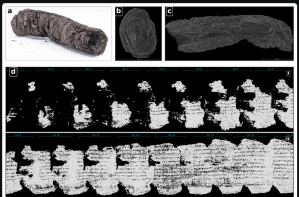
Processing of scroll P.Herc. 1667 (a) The charred scroll,(b) a cross-section, (c) the spiralled sheet inside, (d) The unwrapped surface with columns of text made visible. (Image: Vesuvius Challenge)
In ancient texts that have come down to us, scholars have have many references to other texts that have since been lost. This technology offers a tantalizing glimpse of what may still be found.
For regular updates on the use of AI in scholarship of a less ethical nature, see the literature reported by Denise Nicholson in her Scholarly Horizons.
A recent scoping review of AI in LIS (Torres and Peñaflor 2026) provides an overview of the LIS literature on AI. The authors analysed 387 publications published between 2001 and 2015, and identified six thematic clusters: AI and library practice, academic libraries, diverse contexts, reference services, smart library technologies, and technical foundations. They found that the Global South was underrepresented in the LIS literature. An article by Cox and Mazundar (2024) attempted to define AI from a librarian’s point of view and discussed five types of library applications. The field is likely to evolve rapidly.
This year’s IFLA World Library and Information Congress, held in Busan, Republic of Korea, on 10-13 August, offered a variety of content relating to AI. I counted at least eight sessions in which AI was explicitly addressed, and others in which AI was also implicated. AI featured in the themes of six of the thirteen satellite meetings. Many of the presentations are being posted on IFLA’s DSpace Repository. For your own background, a recent article in American libraries selected four introductory books for librarians and – not to forget – our clients (Esmail 2026).
Tailpiece
For encouraging news to cheer me up, I like to look in American libraries magazine, the magazine of the American Library Association. Our American colleagues have some challenges too, but you can rely on them to come up with new ideas for extending services to their “patrons” (users). Here is an example that I find appealing:
In January 2025 the Mid-Columbia Libraries in Washington State held a speed puzzling tournament, in which teams in the library’s ten branches competed to assemble the same jigsaw puzzle as fast as possible. The winning team, which called itself “Piece Out”, put together the 500-piece jigsaw puzzle in 33 minutes and 23 seconds. Speed puzzling is becoming a popular library activity. It is inexpensive, draws people into the library, and generates camaraderie (Newmark 2026).
References
Cox, Andrew M., and Suvodeep Mazumdar. 2024. “Defining Artificial Intelligence for Librarians.” Journal of Librarianship and Information Science 56 (2): 330–40. https://doi.org/10.1177/09610006221142029.
Esmail, Reanna. 2026. “Considering AI: Books That Approach the Technology Critically.” American Libraries Magazine, January 2. https://americanlibrariesmagazine.org/?p=148676.
Kuba, Ondrej, Jan Stejskal, and Viktor Prokop. 2026. “Are We Ready to Replace Human-Narrated Audiobooks with AI-Narrated Ones? A Case Study of the Municipal Library of Prague.” Journal of Librarianship and Information Science, March 26, 09610006261430947. https://doi.org/10.1177/09610006261430947.
Newmark, Rosie. 2026. “Racing the Clock.” American Libraries Magazine, January 2. https://americanlibrariesmagazine.org/?p=148670.
Pasiak, Greyson. 2026. “Guest Post — AI Fatigue and Vocational Awe in Academic Libraries.” The Scholarly Kitchen, March 4. https://scholarlykitchen.sspnet.org/2026/03/04/guest-post-ai-fatigue-and-vocational-awe-in-academic-libraries/.
Song, Xiaoying, Pengcheng Luo, Jason Thomale, Oksana Zavalina, and Lingzi Hong. 2026. “Comparative Analysis of Large Language Models’ Performance in Book Classification Tasks Using Library of Congress Classification System.” Journal of Information Science, April 7, 01655515261425547. https://doi.org/10.1177/01655515261425547.
Torres, Efren M., and Janice DC Peñaflor. 2026. “Mapping Artificial Intelligence Research in LIS: A Scoping Review.” Journal of Information Science, April 15, 01655515261432507. https://doi.org/10.1177/01655515261432507.


Good Morning Peter:
Thanks for the update. I shall try and read several of the pieces you reference.
Victor and I are doing well – given current circumstances. Our application for Costa Rican residency was rejected because of several mistakes our support organization made in the application. So, we have reapplied and expect to get our documents in mid 2027!! As Costa Ricans are fond of saying in these circumstances, “Pura vida.” I believe these things usually work themselves out in the end. So, I am trying to enjoy the journey.
We sold our mountain cabin last summer. The new owner works for the Malaysian State Oil Company and will not be retiring for several years. So, we rented it back until we decide what to do about Costa Rica. At least I am no longer concerned about forest fires! We may do a driving trip this fall. And this winter, we ae in early planning for a trip to Australia and New Zealand. I sense my travelling days are nearing an end. So, we want to get long trips in while we can.
All the best to you and Monika.
Charles
Charles T. Townley 1531 Pebble Beach Road Las Cruces, NM 88011 575-571-7020 charles.townley@gmail.com
Hi Charles & Victor, Sorry to hear about the delays you are experiencing. \
But it gives you more time to study the bird books available for Costa Rica/Central America, with all those fabulous Neotropical birds, in preparation for your move. In my quest to record 800 Southern African bird species (of which there are are currently around 979) by the time I’m 80, my list has stalled at 766 since last year, with little chance of any expeditions to bird-rich areas that I have not yet visited. Patience is called for, and a windfall of some sort! Greetings, Peter