Library ABC no. 8: VWX

The latest instalment in my Library ABC has been posted here. It covers the letters V, W, and X. I had no photos for the letter X, but a colleague in Germany kindly pointed me to a city named Xanten. That brought back memories. While I was working at IFLA in The Hague I’m sure I must have passed through or close to Xanten on the Intercity train from the Netherlands to Frankfurt am Main, where I went several times for the Frankfurt Book Fair. The Librarian of the Stadbücherei Xanten kindly provided me with a set of lovely images, presenting me with an embarras du choix —they were so good that I could not simply choose one only. Therefore I put together a set of additional images for all three of the selected libraries. Enjoy!

Posted in Uncategorized | Leave a comment

Problematizing digitization: IFLA LTR Satellite Conference, August 2015

Digitization and digital resources have featured in many articles, books and meetings, but mainly the emphasis has been on technology (how to digitize and collect born-digital media), management (how to run an efficient digital programme) and, more recently, curation (managing preservation and access to collections). Not as much attention has been paid to the political issues. To remedy this the IFLA Section of Library Theory and Research has arranged a pre-congress satellite conference in Cape Town on 12 and 13 August 2015 on “Digital preservation as a site of contestation: national heritage, memory, politics and power – beyond technology and management”.  It will address interesting issues of ownership and control of a country’s heritage, memory and traditional/ indigenous knowledge in a digital environment. Related to these are questions about what we mean, for example, by the metaphors of “national memory” and “nation building” in postcolonial situations, and what the roles of libraries and archives can be in such a context.

The conference will be held in three venues. On the first day we will meet on the campus of the University of the Western Cape (UWC). A day of presentations will be followed by a visit to the Mayibuye Archive, which is part of the Robben Island Museum. On the second day (weather permitting) we will take the ferry from Cape Town to Robben Island itself for a guided tour and lecture. We will return to Cape Town for the afternoon session at the District Six Museum.

Registration will cost R300,. This is slightly up from the originally advertised price of R270, due to additional costs. For foreign participants this does not  affect the originally quoted price of EUR 25. But note that this excludes the visit to Robben Island, which currently costs around R280 (around EUR 21). For more information and the pre-registration form, visit the Satellite Conference website, at: http://www.uwc.ac.za/Faculties/ART/Centre-for-Humanities-Research/IFLA/Pages/default.aspx. Here you will find the preliminary programme and the registration form.

The deadline for pre-registration was 30 June but will be extended for a week or so as we still have some places available.  Inquiries may be addressed to ifla@uwc.ac.za.


Posted in Uncategorized | Leave a comment

INFOST 891 Course schedule & bibliography

This Fall (2015) I’m planning to present my International and Comparative Librarianship course, now numbered INFOST 891, again. It’s a three-credit graduate level course in the School of Information Studies (SOIS), University of Wisconsin-Milwaukee (UWM). For general information, here is the Course schedule & readings Fall 2015 provisional and list of required and recommended readings. There may be a few minor changes closer to the beginning of the semester, when the syllabus is issued.

Posted in Uncategorized | Leave a comment

Library STU

Hot off the press: the seventh instalment of my Library ABC covers the letters S, T and U.

Posted in Uncategorized | Leave a comment

Cape Town 2014: Post-Congress Birding?

Around 1995, I put a message on IFLA-L inviting IFLA birders to contact me with a view to forming an IFLA Bird Club. There were four responses. One of the names now escapes me, but Pentti Vattulainen, Charles Townley and I subsequently got together during or after a number of IFLA Conferences, and on some other librarianly occasions, for a bit of international birding. In 1996 Pentti did some challenging early-morning birding in a very smoggy and birdless Beijing. After the Copenhagen Conference in 1997 we went on an expedition to a wetland on the outskirts of that city and were surprised to encounter a living hedge of spotting-scopes – coincidentally a very rare American Golden Plover had been discovered there. After the Bangkok Conference in 1999, with logistical support from the National Library,we had an expedition to a nature reserve in Thailand. Here our enthusiasm for penetrating the jungle was somewhat dampened by the information that wild tigers roamed there freely, and by the attention of leeches. But a walk in a wetland on the outskirts of Buenos Aires in 2004 netted a good haul of lifers for all three of us.

So in 2015 the IFLA Bird Club, had it ever been formally constituted, would have been celebrating its 20th birthday. And since I make my home in South Africa, this seems to me a good excuse to line up, following the Cape Town Congress, a super birding expedition in South Africa and Namibia. I have to emphasize that this is not a formal post-Congress tour. It is a purely private initiative for my IFLA and other birding friends. But we are likely to have some places available for IFLA birders who have not so far been part of our birding activities.

For birding purposes Southern Africa can be roughly divided into a moister eastern part and a more arid central and western part. Most international visitors who want to see birds and animals head for the Kruger National Park and the game reserves of KwaZulu-Natal — many IFLA delegates who came to Durban for the 2007 Conference will have seized that opportunity. The trip I’m planning for 2015 will take in the western half of Southern Africa, home of many endemic species, from Cape Town in the South, through the Fynbos and Karoo Biomes into Namibia, and as far north as the Angolan border on the Kunene River. The tour will be led by an experienced bird guide, Japie Claassen, who specializes in this region. For an impression of the birds that may be seen, I have posted here a report on such a trip in August 2013. Japie is knowledgeable about other fauna and flora too. We’ll see a lot of animals. Although we will not look only at birds, participants will need to be birder-tolerant.

We are thinking of tour lasting 19 to 25 days and costing between ZAR 26,700 and ZAR R37,800. (For USD, divide by ten; for Euros, divide by 15, approximately.) It could be scaled down if necessary.

I can provide more information, including draft itineraries to any interested IFLAites. I can be contacted at peterjlor[at]geemail.com.


Posted in Uncategorized | Tagged | Leave a comment

L’Arbre aux livres

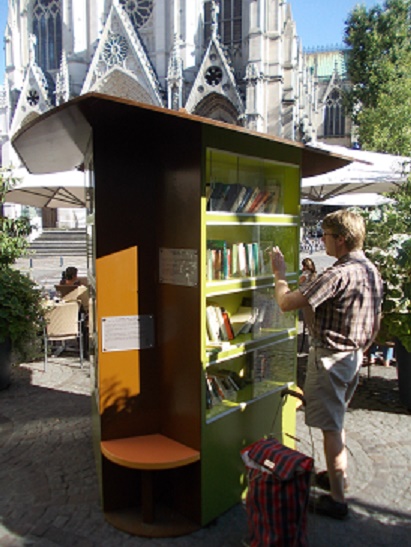
Before heading for the  80th IFLA Conference World Library and Information Congress, in Lyon, we spent a few days in the lovely city of Nancy, in the Lorraine region of France. Strolling around the Vieille Ville (old town) quarter we came across “L’Arbre aux Livres” (the book tree). This turned out to be a French version of the little free libraries that have been spreading like wildfire across the world since their inception a few years ago.

l'Arbre aux Livres, (Little Free Library) Nancy, France: volunteer restocking and tidying the collection

l’Arbre aux Livres, (Little Free Library) Nancy, France: volunteer restocking and tidying the collection

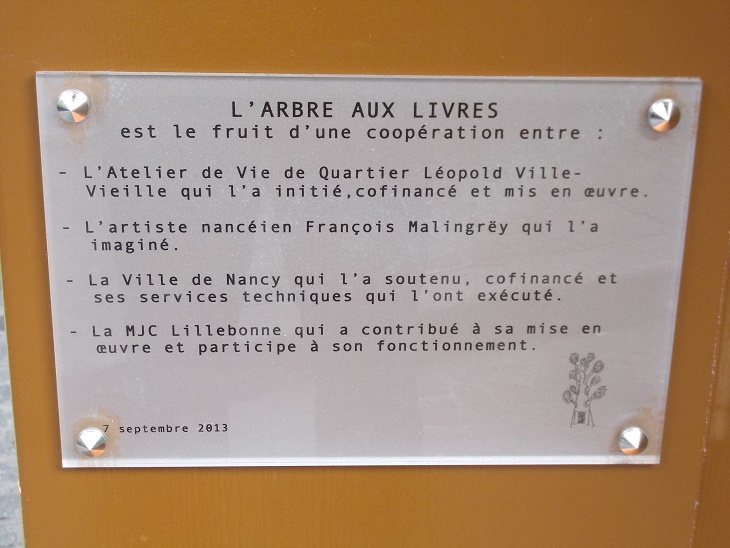
I spoke briefly to a volunteer who was busy adding some books and putting the collection back into some semblance of order. [Some disorder on library shelves is a sign of vitality; if everything is in perfect order, you have a problem — but that’s another story.] This little free library was the result of a collaboration by several parties:

DSCN2349 lArbre aux livres notic

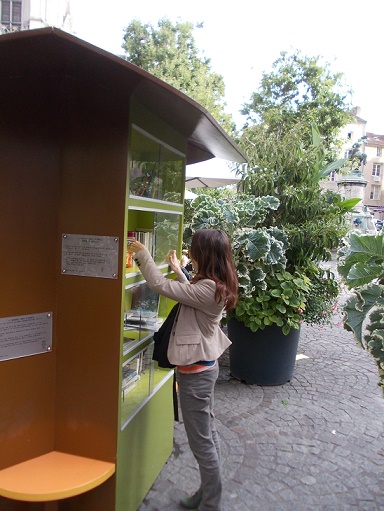
As in the USA and elsewhere, anyone is free to borrow books and add their own contributions to the collection. L’arbre aux livres is located on a busy square, adjoining a well-frequented brasserie. It was good to see a constant stream of patrons of this establishment, both young and old, interrupting their consumption of beer and wine to sample the books.

DSCN2351 lArbre aux livres3

There are worse things in life than sipping wine and browsing bookshelves on a mild evening as the sun is setting in Nancy.

À votre santé!

Posted in Uncategorized | Tagged | Leave a comment

Peter’s Library ABC, 6th instalment: PQR

I’ve been reminded that I haven’t yet posted here the sixth instalment of my Library ABC. Every year, around Christmas/New year, I send out a newsletter to friends and colleagues. It has some professional and personal news, and I add to it a page on which I put pictures of three libraries,with brief information or comments about them. The names of the libraries, or the names of the cities in which they are located, start with three consecutive letters of the alphabet. I started at ABC at Christmas 2008, did DEF in the following year, and so forth. You can find more info and the first five instalments here. Last Christmas (2013) I sent out the sixth instalment, covering the letters P, Q and R. I’ve now posted this as well, here.

Posted in Uncategorized | 1 Comment

LTR Satellite meeting planned for Cape Town 2015

I recently learned that IFLA’s Professional Committee has approved a proposal from the Section of Library Theory and Research to hold a pre-congress satellite meeting in Cape Town in August 2015.

The theme of the meeting is “Digital preservation as a site of contestation: national heritage, memory, politics and power – beyond technology and management”.  It will address interesting issues of ownership and control of a country’s heritage, memory and traditional/ indigenous knowledge in a digital environment. Related to these are questions about what we mean, for example, by the metaphors of “national memory” and “nation building” in postcolonial situations, and what the roles of libraries and archives can be in such a context.

The Satellite meeting is planned for 12 and 13 August 2015. It will be held in two venues. On the first day we will meet on the campus of the University of the Western Cape (UWC), in the outskirts of Cape Town. This is an appropriate venue as UWC hosts the Mayibuye Archive, which is part of the Robben Island Museum. On the second day we will take the ferry from Cape Town to Robben Island itself, where the rest of the programme will take place, along with a guided tour of the prison compound where liberation struggle leader and South Africa’s first democratically elected president, Nelson Mandela, was incarcerated.

This should be a memorable event, which will be of interest to IFLA members and other interested persons concerned with digital preservation of documentary heritage, including librarians responsible for digitization and digital collections management, archivists, museum curators; also historians and other academics. Members of First Nations communities concerned with the preservation of their traditional/indigenous knowledge and ethical management thereof are also among the potential audience.

Watch out for the Satellite Meeting announcement in the run-up to the 2015 IFLA World Library and Information Congress!

Posted in Uncategorized | 2 Comments

Some new resources

It’s Spring Break at UWM and I’ve used the opportunity to update this site, which was woefully out of date. It still needs a lot of updating, but there are some new resources, particularly on the Presentations page, where I’ve added material dating for 2010 to 2013, with references and links. I’ve also posted the course schedule and list of readings from the syllabus for my Spring 2014 course in International and Comparative Librarianship.

Posted in Comparative Librarianship | Leave a comment

Chapter 7 – International Influence and Diffusion in Library and Information Services

At last! I have posted a draft of Chapter 7, “International influence and diffusion of ideas in LIS”.  This chapter first introduces the concept of diffusion, and gives an overview of the ground-breaking generalized model of the diffusion of innovations of Everett M. Rogers, also touching on some limitations of his model.

The application of diffusion theories in ICT and information systems, still heavily influenced by Rogers and employing newer, but largely Rogers-inspired models, is critically discussed. I then to turn to other disciplines where theory has been developed to understand the diffusion of more complex phenomena, referred to as lesson drawing, social learning, policy diffusion, policy borrowing, etc. Useful insights can be gained from applied fields in the social sciences such as public policy, public administration, social policy and social work, and particularly from comparative education, which has from its beginnings had a strong focus on policy borrowing. In a section presenting a “framework for transfer (diffusion) in LIS” I have tried to wrap up these various insights as they appear to me to be relevant and useful for our field. The final section, a long one, deals with LIS-related diffusion and influence in Europe. There is a great deal of material here, so I have had to be selective, looking at American influence on librarianship in Western Europe before WW2, American influence in occupied Germany and (briefly) Japan, American influence in Russia, the Soviet Union and its satellites, and the role of the European Union (and the Council of Europe) first in relation to integration in Western Europe and then in relation to the EU’s eastward enlargement. I conclude by listing some other spheres of influence worth investigating, but LIS-related diffusion and influence in the developing world will be dealt with in Chapter 8, “Library development aid and influence”, which is still in the pipeline. The bibliography for Chapter 7 currently includes 184 items. The Bibliography for Chapter 8 may well be longer. All this is taking a lot of time…

What about Chapter 6? Chapter 6 is missing due to an ongoing reorganization of the five introductory chapters. A new Chapter 3 will be added, so that the current chapters 3, 4, and 5 will become chapters 4,5 and 6 respectively. Watch this space (but don’t hold your breath).

Posted in Comparative Librarianship, International Librarianship, Research, The Book | Tagged , , , , , , , , , , | Leave a comment