L’Arbre aux livres

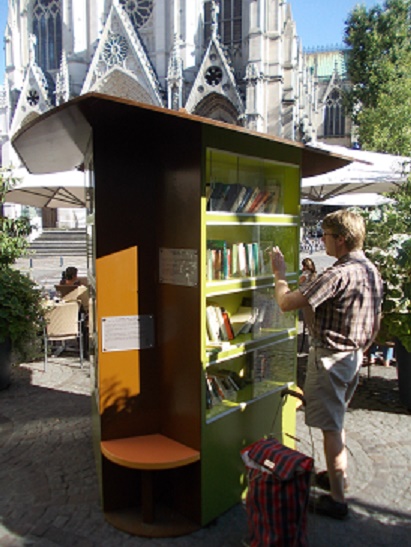
Before heading for the  80th IFLA Conference World Library and Information Congress, in Lyon, we spent a few days in the lovely city of Nancy, in the Lorraine region of France. Strolling around the Vieille Ville (old town) quarter we came across “L’Arbre aux Livres” (the book tree). This turned out to be a French version of the little free libraries that have been spreading like wildfire across the world since their inception a few years ago.

l'Arbre aux Livres, (Little Free Library) Nancy, France: volunteer restocking and tidying the collection

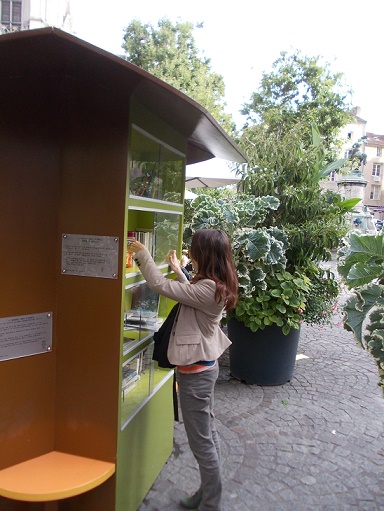
l’Arbre aux Livres, (Little Free Library) Nancy, France: volunteer restocking and tidying the collection

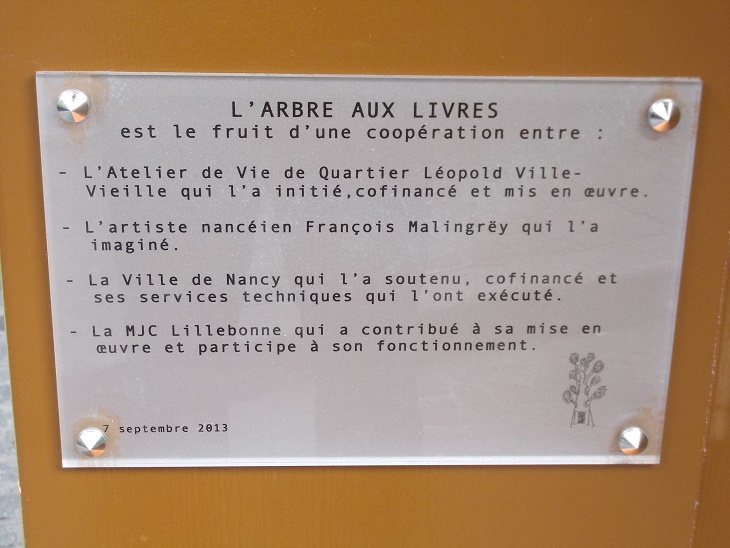
I spoke briefly to a volunteer who was busy adding some books and putting the collection back into some semblance of order. [Some disorder on library shelves is a sign of vitality; if everything is in perfect order, you have a problem — but that’s another story.] This little free library was the result of a collaboration by several parties:

DSCN2349 lArbre aux livres notic

As in the USA and elsewhere, anyone is free to borrow books and add their own contributions to the collection. L’arbre aux livres is located on a busy square, adjoining a well-frequented brasserie. It was good to see a constant stream of patrons of this establishment, both young and old, interrupting their consumption of beer and wine to sample the books.

DSCN2351 lArbre aux livres3

There are worse things in life than sipping wine and browsing bookshelves on a mild evening as the sun is setting in Nancy.

À votre santé!

Posted in Uncategorized | Tagged | Leave a comment

Peter’s Library ABC, 6th instalment: PQR

I’ve been reminded that I haven’t yet posted here the sixth instalment of my Library ABC. Every year, around Christmas/New year, I send out a newsletter to friends and colleagues. It has some professional and personal news, and I add to it a page on which I put pictures of three libraries,with brief information or comments about them. The names of the libraries, or the names of the cities in which they are located, start with three consecutive letters of the alphabet. I started at ABC at Christmas 2008, did DEF in the following year, and so forth. You can find more info and the first five instalments here. Last Christmas (2013) I sent out the sixth instalment, covering the letters P, Q and R. I’ve now posted this as well, here.

Posted in Uncategorized | 1 Comment

LTR Satellite meeting planned for Cape Town 2015

I recently learned that IFLA’s Professional Committee has approved a proposal from the Section of Library Theory and Research to hold a pre-congress satellite meeting in Cape Town in August 2015.

The theme of the meeting is “Digital preservation as a site of contestation: national heritage, memory, politics and power – beyond technology and management”.  It will address interesting issues of ownership and control of a country’s heritage, memory and traditional/ indigenous knowledge in a digital environment. Related to these are questions about what we mean, for example, by the metaphors of “national memory” and “nation building” in postcolonial situations, and what the roles of libraries and archives can be in such a context.

The Satellite meeting is planned for 12 and 13 August 2015. It will be held in two venues. On the first day we will meet on the campus of the University of the Western Cape (UWC), in the outskirts of Cape Town. This is an appropriate venue as UWC hosts the Mayibuye Archive, which is part of the Robben Island Museum. On the second day we will take the ferry from Cape Town to Robben Island itself, where the rest of the programme will take place, along with a guided tour of the prison compound where liberation struggle leader and South Africa’s first democratically elected president, Nelson Mandela, was incarcerated.

This should be a memorable event, which will be of interest to IFLA members and other interested persons concerned with digital preservation of documentary heritage, including librarians responsible for digitization and digital collections management, archivists, museum curators; also historians and other academics. Members of First Nations communities concerned with the preservation of their traditional/indigenous knowledge and ethical management thereof are also among the potential audience.

Watch out for the Satellite Meeting announcement in the run-up to the 2015 IFLA World Library and Information Congress!

Posted in Uncategorized | 2 Comments

Some new resources

It’s Spring Break at UWM and I’ve used the opportunity to update this site, which was woefully out of date. It still needs a lot of updating, but there are some new resources, particularly on the Presentations page, where I’ve added material dating for 2010 to 2013, with references and links. I’ve also posted the course schedule and list of readings from the syllabus for my Spring 2014 course in International and Comparative Librarianship.

Posted in Comparative Librarianship | Leave a comment

Chapter 7 – International Influence and Diffusion in Library and Information Services

At last! I have posted a draft of Chapter 7, “International influence and diffusion of ideas in LIS”.  This chapter first introduces the concept of diffusion, and gives an overview of the ground-breaking generalized model of the diffusion of innovations of Everett M. Rogers, also touching on some limitations of his model.

The application of diffusion theories in ICT and information systems, still heavily influenced by Rogers and employing newer, but largely Rogers-inspired models, is critically discussed. I then to turn to other disciplines where theory has been developed to understand the diffusion of more complex phenomena, referred to as lesson drawing, social learning, policy diffusion, policy borrowing, etc. Useful insights can be gained from applied fields in the social sciences such as public policy, public administration, social policy and social work, and particularly from comparative education, which has from its beginnings had a strong focus on policy borrowing. In a section presenting a “framework for transfer (diffusion) in LIS” I have tried to wrap up these various insights as they appear to me to be relevant and useful for our field. The final section, a long one, deals with LIS-related diffusion and influence in Europe. There is a great deal of material here, so I have had to be selective, looking at American influence on librarianship in Western Europe before WW2, American influence in occupied Germany and (briefly) Japan, American influence in Russia, the Soviet Union and its satellites, and the role of the European Union (and the Council of Europe) first in relation to integration in Western Europe and then in relation to the EU’s eastward enlargement. I conclude by listing some other spheres of influence worth investigating, but LIS-related diffusion and influence in the developing world will be dealt with in Chapter 8, “Library development aid and influence”, which is still in the pipeline. The bibliography for Chapter 7 currently includes 184 items. The Bibliography for Chapter 8 may well be longer. All this is taking a lot of time…

What about Chapter 6? Chapter 6 is missing due to an ongoing reorganization of the five introductory chapters. A new Chapter 3 will be added, so that the current chapters 3, 4, and 5 will become chapters 4,5 and 6 respectively. Watch this space (but don’t hold your breath).

Posted in Comparative Librarianship, International Librarianship, Research, The Book | Tagged , , , , , , , , , , | Leave a comment

Peter Lor’s Library ABC

The content of this post has been moved here.


Posted in Library ABC | 2 Comments

Access to knowledge handbook

Consumers International (CI), the world federation of consumer groups founded in 1960, has released the second edition of its handbook, Access to Knowledge: A Guide for Everyone. Its aim is to provide a concise and nonspecialist introduction to IP and A2K issues, and selected related issues of communications rights and access to information and communication technologies (ICTs). Its intended readership includes consumer groups and NGOs (non-governmental organisations) who wish to become more knowledgeable in this area, individual academics and activists who could use a simple reference guide to the many related issues of A2K, and consumers at large who are affected by unfair IP laws and practices.

The first edition of this book was distributed with a DVD copy of Consumers International’s film When Copyright Goes Bad, and also included a range of freely-licensed books, videos, software, photos and music recordings on DVD ROM. This has been removed for the second edition, but the film remains available for viewing or download from Consumers International’s Web site at http://A2Knetwork.org/film. Some minor corrections to the text have also been made in this edition.

It can be downloaded in pdf format in English, Spanish and French at http://a2knetwork.org/announcing-access-knowledge-guide-everyone.

(Adapted from Preface.)

Posted in Information justice | Leave a comment

Pirates!

There is never a dull moment at an IFLA Congress. This afternoon in Gothenburg we were addressed by a pirate. The joint session of FAIFE (Free Access to Information and Freedom of Expression) and the Section of Information Technology featured Christian Engström, who represent’s Sweden’s Pirate Party (Piratpartiet) in the European Parliament.

He started by drawing an analogy between Pirate Bay (where people can obtain copyrighted stuff free of charge for their personal enjoyment) with libraries, where people can obtain copyrighted stuff free of charge for their personal enjoyment. (Of course, I have used the word “obtain” to refer to two rather different operations. And Mr Engström eliminated public lending right (PLR) from the discussion. PLR is a mechanism in terms of which authors in some countries receive payments in proportion to the number of times their books are borrowed by library patrons. He does not consider this to constitute compensation of rights holders but rather as a form of cultural policy to encourage Swedish authors. All this, of course, is a bit more complicated than can be put in a few sentences.)

Mr  Engström stressed that the Pirate Party does not want to abolish copyright, but to reform it. Copyright should be confined to business-to-business transactions and not apply to what private citizens do to gain access to information and culture. Here is his party’s reform agenda:

(1)    The moral rights of authors should remain unchanged. (In fact, he claims that netiquette already ensures this, since on the Internet there is peer pressure for people to give credit for materials they borrow from others, by making links to the original sites.)

(2)   All non-commercial use should be free, as it was for all practical purposes, until about twenty years ago.

(3)   The term of copyright should be reduced to five years. (He says no serious investor expects payback on an investment to come seventy-plus years down the line.)

(4)   Rules on derivative works should be relaxed, since all culture builds on previous work. [I like this. Most of Shakespeare’s storylines were lifted from other authors. Under the current copyright regime Shakespeare would be spending too much time in court to write any plays. PJL]

(5)   DRM technology should be banned.

Mr Engström mentioned two reasons for this position:  First, culture is a good thing, and relaxing copyright restrictions will stimulate cultural production. Second, in the digital age copyright can only be enforced by monitoring all private communications on the Internet, which would be an intolerable invasion of privacy.

Points to ponder…

Posted in Uncategorized | Leave a comment

Marathon session, August 12th

After hearing Henning Mankell’s deservedly well-attended plenary address, I spent most of the rest of today in the joint session of the sections of Management of Library Associations, Library Theory and Research, Management and Marketing, Education and Training, and Statistics and Evaluation, and the SIG for LIS Education in Developing Countries (sessions 87 and 97). This was the first part of a two-year initiative to clarify and give direction to LIS research for national advocacy.  The two keynotes were especially noteworthy. Sue Hutley spoke about a comprehensive national advocacy program in Australia and in doing so gave a thorough, all-round introduction to national advocacy for LIS. See http://www.ifla.org/files/hq/papers/ifla76/87-hutley-en.pdf.

The second keynote, in the afternoon session, was by Sharon Markless and David Streatfield, who spoke about “Impact evaluation, advocacy and ethical research: some issues for national strategy development”, available at http://www.ifla.org/files/hq/papers/ifla76/97-markless-en.pdf.  This was a thoughtful and thought-provoking paper, of interest on the one hand because the authors presented a kind of typology in which national evaluation and advocacy activities were related to the level of library development of various categories of countries — grist to my mill of international and comparative librarianship. On the other hand, they raised a number of ethical issues relating to in-house and outsourced evaluation exercises. Warmly recommended.

A bit late in the day, let me use this opportunity to encourage anyone who is still hesitating about getting up early enough tomorrow, to do so and attend Hans Rosling’s plenary address at 08:30 in Hall B.  Why? Check out http://www.ted.com/index.php/talks/hans_rosling_shows_the_best_stats_you_ve_ever_seen.html.

Enjoy!

Posted in Uncategorized | Leave a comment

Högsbo Public Library, August 10th

One of the pleasures of not being a secretary general is being able to join in activities that ordinary delegates can take time out to do, such as library visits. This year I chose Library Visit #18, to Högsbo Public Library. It serves a population of around 17.000 in a suburb of Gothenburg and is located in a building erected in 1954 as part of a small shopping center. The building, which was extended in 1999, is not particularly striking but it seems functional and has worn well. A collection of around 30.000 items is on offer, and around 600 library visits are recorded daily. The staff numbers six, of whom four librarians. And they keep pretty busy. We were impressed with the activities on offer. This is grassroots, community-orientated librarianship in action, Swedish style.

See a few pictures of my visit at: http://picasaweb.google.com/PeterJLor/HogsboPublicLibrary#

Thank you, Swedish colleagues, for arranging this visit and the many others, and thank you, Högsbo librarians, for your hospitality.

Posted in Uncategorized | Tagged | Leave a comment